Saturday, October 07, 2017

“Spielberg”– Movie Review


ssdoc

This week at The 55th New York Film Festival, I caught the World Premiere of the new documentary, “Spielberg”.

Synopsis

A documentary that analyzes how the legendary director’s personal life influenced his professional work. 

Story

As a child, Steven Spielberg was something of a loner.  Growing up in Arizona, he didn’t have many friends.  He did, however, have an astounding ability to internalize exactly what made a good movie from the standpoint of visual storytelling as well as the ability to execute that that in the films he would make in his youth.  Exactly how he figured out how to do this isn’t clear – it can only be explained that it is simply a part of what makes the man a genius filmmaker.  While these movies might look primitive on the surface, considering that a boy who was yet to take his first filmmaking class figured out how to simulate special effects is something of a marvel. 

Spielberg grew up with two sisters, who wound up appearing in some of his childhood films, albeit not always voluntarily.  What he tried to do in his movies then was not only to scare his sisters but also scare himself as well; he grew up feeling always afraid as a kid as he was extensively bullied in school.  Even the filmmaker admits that he never went into therapy precisely because filmmaking was his therapy – he worked out all of his personal demons by making a movie about them.  This explains why he would multitask, editing one film while reading a script for his next. 

In the end, Spielberg remains completely unapologetic about the brazen sentimentality in his films.  If the critics say his movies lack certain artistic qualities and that his work is not intellectual enough, let them.  All he cares about is telling a great story in a compelling fashion.  As a teenager, Spielberg saw “Lawrence Of Arabia” in a theater where it was shown in 70mm; he felt that the film was so majestic, he should abandon his dream of becoming a filmmaker because he would never be able to do anything as good as – much less better than – that movie.  But subsequent viewings of the film turned him around – the motion picture became his greatest inspiration.   

Review

At two and a half hours in length, “Spielberg” is nearly twice as long as most documentaries.  This might be explained by the fact that its subject has a rather long career with an extensive body of work and that he has also had a significant impact on our popular culture internationally, but especially in America.  That might explain it, but it’s no justification.  In terms of informational nutrition, this documentary is filled with nothing but empty calories because there’s not much new or revelatory information in its content; while the director himself is worthy of a documentary, the documentary is not worthy of its length.   

It is your typical documentary, filled with talking heads (including Spielberg himself as well as the cast and crew who’ve worked with him over the years), padded with clips from his films and occasional excerpts from home movies.  If you are a casual movie fan or a casual fan of Spielberg, you might find some of the information interesting but if you have read or seen interviews of him over the years, there’s nothing new here.  On the other hand, only a hardcore Spielberg aficionado or movie buff, then you might find the length less objectionable because it apparently is attempting a deep dive. 

One thing that’s somewhat puzzling about this documentary is the omission of the fact that Spielberg had Jerry Lewis as a filmmaking teacher at The University of Southern California.  Why was Jerry Lewis not interviewed for this film?  Was he asked and he declined?  If so, that would have been interesting to include in the story.  Was he never asked in the first place?  Why was Spielberg not asked about Jerry Lewis in the final form of this documentary?  This was a reasonably well-known fact (among some of the others in the motion picture) and sadly, its absence is the only thing remarkable about this documentary. 

Spielberg (2017) on IMDb

Monday, October 02, 2017

“The Meyerowitz Stories” – Movie Review

meyerowitz

On the first weekend of The 55th New York Film Festival, I attended the North American Premiere of the new Noah Baumbach comedy-drama, “The Meyerowitz Stories (New and Selected)”, starring Adam Sandler, Ben Stiller and Dustin Hoffman.

Synopsis

As an elderly father nears his final days, will he be able to resolve issues with his adult children – and can they resolve the issues they have with each other? 

Story

In his prime, Harold Meyerowitz (Hoffman) was once considered an influential sculptor by critics, colleagues and his students alike.  He does not share their opinion of him; focusing on his career, he was not very successful in his personal life.  Harold has married several times with adult offspring from different wives – Danny (Sandler), Matt (Stiller) and Jean (Elizabeth Marvel).  His current wife, Maureen (Emma Thompson), is a bit eccentric, to put it mildly; although she provides Harold with companionship, she’s struggling to stay sober as she feels like something of an outsider in this family. 

Making Harold feeling even more distraught is the fact that one of his contemporaries, L.J. Shapiro (Judd Hirsch), has his own career resurrected when he’s suddenly finding great fame late in life.  Harold attends a showing of Shapiro’s work at a gallery and becomes so resentful, he abruptly leaves, envious and embarrassed.  Meanwhile, he is forced to deal with Danny’s issues; separated from his wife, Danny’s seeing his daughter Eliza (Grace Van Patten) off to college.  A failed musician, Danny is struggling to get by financially and Eliza’s college is yet another burden.

Visiting from California, Matt, a financial advisor, tries to convince Harold to sell his home and move into a less expensive place.  Matt’s half-brother Danny objects because he wants his father to spend his remaining time in a familiar space.  This causes the resentment the half-brothers harbored for decades to come to the forefront.  Sharing a father but coming from different mothers, they felt that they had to compete for Harold’s love and attention.  While the debate over selling the house rages on, Harold is hospitalized due to a brain injury he incurred after a fall.  Not knowing whether or not Harold will pull through, will his three children be able to resolve their outstanding issues with their father?  For that matter, can they put their own differences aside as well?

Review

Baumbach’s latest explores a considerable amount of familiar territory; this is probably good news for his fans and perhaps something of a disappointment for those who are less enthusiastic when it comes to this filmmaker’s body of work.  Not that revisiting themes we’re accustomed to seeing from a director is necessarily a bad thing – as long as it’s done well, at at any rate.  Familial conflict has typically been Baumbach’s métier, so he cannot be blamed for returning to the well, especially if that’s what drives him creatively.  For those familiar with his earlier work, “The Meyerowitz Stories” almost could be considered a sequel to “The Squid And The Whale”.  However, despite the series of interesting tales, its ending is something of a letdown. 

Where “The Meyerowitz Stories” diverges from “The Squid And The Whale” is with its underlying theme on the nature of success.  Success, the movie seems to say, is both personal and subjective; what determines defining something as a success will vary individually, depending on context – it’s all relative.  Harold, despite how others view him, feels he has been unsuccessful.  Danny never followed through on his musical studies, so he believes himself to be a failure.  Matt didn’t pursue a career in the arts, so regardless of his income, thinks he is not a success in his father’s eyes.     

What makes “The Meyerowitz Stories” worth seeing is its stellar cast; this is truly a remarkable ensemble performance all around – and yes, that even includes Adam Sandler.  But while the story centers on the sibling rivalry between Sandler’s character and Stiller’s, the performance worth viewing is that of Dustin Hoffman; his nuanced portrayal as the father shows he’s still got plenty in the tank.  He plays an artist who never really understood how aloof he was with his wives or children and lacks the introspection to acknowledge his behavior.

Following the screening was a question and answer session with the cast, writer/director and composer Randy Newman, who wrote the soundtrack.  Perhaps the most incisive and salient observations about “The Meyerowitz Stories” were made by Hoffman himself, who noted that while the film is heavily stylized, it is so subtle that it can be easy to miss.  He found the pacing of the movie noteworthy given the fact that it clocks in at under two hours although the script was 170 pages.  Another good comment he made was about Newman’s soundtrack; the music is that of Newman solo on the piano, giving a sad and lonely sound appropriate to the characters in the movie.  

The Meyerowitz Stories (New and Selected) (2017) on IMDb

Saturday, September 30, 2017

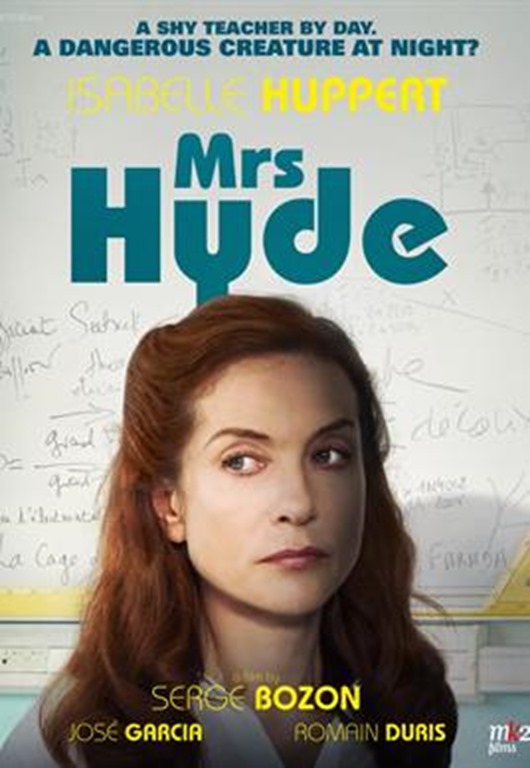
“Mrs. Hyde”– Movie Review


MHyde

This week at The 55th New York Film Festival, I attended the North American Premiere of the comedy-drama, “Mrs. Hyde”, starring Isabelle Huppert. 

Synopsis

When a high school science teacher suffers an accident which gives her unusual powers, will she be able to control her newfound abilities or will they control her?

Story

Marie Géquil (Huppert) is hated by her students and her colleagues do not seem to hold her in very high esteem either.  As a science teacher at a suburban technical high school, her class treats her with derision.  It seems this woman is far too timid to be taken seriously.  But while teaching is her career, science is her passion; as such, she maintains her own lab on school grounds where she can perform her own experiments in order to better teach her class.  One day in her laboratory, an accident happens where she is apparently electrocuted during a storm.   This permanently transforms her life.

Although neither her husband nor her co-workers notice any change initially, Mrs. Géquil certainly does – and adapting to it is far from easy for her.  As it turns out, she has been imbued with some kind of power – an electrical power, to be precise – which is difficult for her to control, even after she becomes aware that it is now in her possession.  But there is yet another transformation that takes place in Mrs. Géquil and that has to do with her personality.  It seems that she has become more confident, less fearful of her students – and that leads to classes where these young men and women are increasingly engaged and as a result are learning more. 

Mrs. Géquil begins mentoring one of her students – Mallik, a handicapped teenager who just wants to fit in with the other kids, but because of his disability, they are not quite so accepting of him.  Géquil recognizes Mallik is both willing and able to learn, so she conducts extracurricular sessions with him in order to assist the young man with his studies.  But just as Mallik starts to excel in his education, so does  Mrs. Géquil change in her behavior; overnight, her electrical powers transform her into a murderer and when she tries to make Mallik one of her victims, will she succeed or can the police stop her before Mallik loses his life?           

Review

When a director has to explain his movie to a group of people who have just screened it, that does not speak well of the work.  Nevertheless, that is precisely what happened after the showing of “Mrs. Hyde” – but more on that later.   This is something of an oddball film in the sense that it is neither entirely a comedy nor something that fits easily into a horror/science fiction genre.  Also, it is clearly not a strict adaptation of the Robert Louis Stevenson classic novel, “The Strange Case Of Dr. Jekyll And Mr. Hyde” – although that is admittedly what inspired this version of the story. 

In this updated distaff reboot, Mrs. Géquil (Jekyll) is a science teacher in the modern day, who instructs a class of woebegone students who may have some degree of potential.  Here, however, we have more sympathy with her than terror, despite her hideous deeds.  It is obvious that she is not in complete control, despite the actions of the character.  Much like Linda Blair’s portrayal in “The Exorcist”, you root for the defeat of the demon which possesses her rather than rooting against the character herself; that being the case, however, the deaths that occur seem more incidental than intentional. 

Following the screening was a question and answer session with director/writer Serge Bozon and star Isabelle Huppert, as mentioned above.  Since Bozon ate up much of the time clarifying his story for the audience, Huppert, unfortunately, did not get much of an opportunity to answer questions.  She did, however, share that this role was a great challenge for her because it was difficult for her to memorize her lines; since her character is a science teacher and she has precious little knowledge of the subject, much of the technical language was hard to internalize. 

Madame Hyde (2017) on IMDb

confo_cadre_def

Friday, September 29, 2017

“Last Flag Flying”– Movie Review


LFF

On the opening night of The 55th New York Film Festival, I attended the World Premiere of director Richard Linklater’s new comedy-drama, “Last Flag Flying”, starring Steve Carell, Bryan Cranston and Laurence Fishburne. 

Synopsis

When a trio of Vietnam War veterans reunite to help bury one of their sons, will they be able to resolve a dark secret from their shared past?

Story

In 2003, America finds itself in the incipient days of The Iraq War.  It is at this point that Doc (Carell), decides to look up Sal (Cranston), an old buddy of his from decades ago – Doc and Sal both served together in the military during The Vietnam War.  Doc convinces Sal to leave the bar he now owns so they can meet up with the final member of their troika, Mueller (Fishburne), who used to lead them in their long-gone days of raising hell.  Sal is chagrined to learn that the wild man he once knew Mueller to be is now a minister well regarded by his congregation.  

Over a meal at Mueller’s house, Doc reveals the reason for this sudden reunion:  his son, a Marine, just died while serving in Iraq.  As a recent widower, finds he cannot bury his son by himself, so he calls upon the two friends from his youth to provide him with the emotional support he so desperately needs.  While Sal is willing to help, Mueller is extremely reluctant.  Finally, at his wife’s urging, Mueller agrees to join them.  Although Doc’s son will be buried at Arlington National Cemetery with other military heroes, they must first venture to The Dover Air Force Base to receive the body. 

While there, the trio learn the real way in which Doc’s son perished.  Upon hearing this, Doc now feels he should not be interred at Arlington; instead, he wants to take his boy back to his home in New Hampshire and have him laid to rest there.  With this, the men travel with the body via train to Doc’s home.  Along the way, they find compelled to revisit a period from their time in the military which they’d prefer to forget because it resulted in the death of one of their military brothers.  Decades later, can this triumvirate find a way to right an old wrong so they can bury Doc’s son with a clear conscience?   

Review

It is likely that most professional film critics will fall all over themselves gushing over “Last Flag Flying” in their review.  There are many reasons for this:  for one thing, they see this as a serious contender for awards and they don’t want to miss the boat calling this one.  For another thing, it is an anti-war movie, so they will feel obligated to throw their support behind it for fear of not appearing politically correct.  Also, there is the matter of the names associated here:  director Linklater (whose “Boyhood” from a few years ago earned many nominations) and the stars – Carell, Cranston and Fishburne – who are among the finest in this country. 

Keeping all of that in mind, perhaps it is now time to tell The Emperor he’s not wearing any clothes.  “Last Flag Flying” is based on the novel by Darryl Ponicsan, who co-wrote the screenplay with Linklater.  The big screen adaptation is rather lacking in dramatic impact, although reading its original narrative version may have resulted in a more emotional effect.  This is one of those buddy road movies where the buddies don’t always like each other, which is what generates some of the comic moments; it has been unfairly but inevitably compared to the old Jack Nicholson film, “The Last Detail”.  While “The Last Detail” is really something of a coming of age story, “Last Flag Flying” is more of a coming to terms story.     

As far as the performances are concerned, Carell and Fisburne are superb in their understated portrayals whereas Cranston, for all of his talent, really just appears to be chewing the scenery much of the time.  This acting choice was probably based on two factors:  first, his manic character is a stark contrast against the other two, which makes him stand out all the more.  Also, Sal is supposed to have a metal plate in his head, as the result of a war injury; taking this into consideration, it probably seemed acceptable to play the character as broadly as possible.   

Last Flag Flying (2017) on IMDb

Wednesday, September 20, 2017

“Battle Of The Sexes”– Movie Review


BOTS

This week, I attended a New York Times Film Club screening of “Battle Of The Sexes”, starring Emma Stone and Steve Carell. 

Synopsis

When The Women’s Liberation Movement comes to the forefront in American culture, can a top woman tennis player defeat a retired older male tennis player?

Story

In 1973, The Women’s Liberation Movement was gaining steam throughout The United States.  Main among its causes was equal pay; women were not being compensated fairly in comparison to their male counterparts.  This was prevalent in all walks of life, including and especially in highly visible areas, such as professional sports.  At this time, Billie Jean King (Stone) was considered among the best female tennis players.  She becomes outraged when the older men who control the sport refuse to award prize money to the women that is equivalent to what the male players would win. 

Mrs. King retaliates by starting her own women’s tennis league, recruiting all of the best professional players; when it earns sponsorship from a cigarette targeted for women, they are then able to promise prize money that is commensurate with what the men would get.  As this group is forming, King meets Marilyn (Andrea Riseborough), a hairdresser who awakens King to an aspect of her sexuality that had long since remained dormant.  This proves problematic to King not just because she’s already married, but also because if this information became public, it would ruin her career permanently.

Upon hearing of this women’s league, retired tennis player Bobby Riggs (Carell) is inspired.  Needing money to pay gambling debts – and seeking the limelight he once had during his days as a player – Riggs contacts King to suggest the two play each other to prove once and for all if men are better than women in tennis.  King rejects the notion, but Riggs convinces her main competitor Margaret Court (Jessica McNamee) to agree.  Once Riggs beats Court, King quickly reconsiders.  Thanks in large part to Riggs’ skills as a master showman, the media rapidly latch on to this story; once it’s on everyone’s radar, it becomes the world’s most anticipated sporting event.  But will King succumb to the intense pressure or can she find a way to defeat the bloviating Riggs?    

Review

What holds back “Battle Of The Sexes” most is its hackneyed screenplay.  Despite both main characters being humanized with their own personal struggles – Riggs with his gambling addiction and King with her sexuality – there is not enough that’s special about the way this story is told that draws in the viewer on an emotional level.  Once we see Riggs as a devoted father and as a husband whose finances challenges the patience of his wife, it is increasingly difficult to root against him.  True, it could be argued that his chauvinism alone is reason enough, but even that comes across as something of an act for this “show” he’s trying to put on.  It turns out that Riggs is not the villain in this story, it is instead tennis broadcaster and advocate Jack Kramer (Bill Pullman) – and therein may lie another issue.  

King’s character should be easier to root for, but that’s not always the case.  It’s not that she comes across as a villain, it’s that some of the people whom she opposes aren't necessarily all that unlikeable.  For example, Margaret Court doesn’t appear as an unpleasant person, but King nevertheless dislikes her for reasons that seem to go beyond merely due to their professional rivalry.  Then there is the matter of King cheating on her husband Larry; while we feel for King’s inability to be more open about her lesbianism, we also feel for her husband, who (at least based on the movie) was faithful to his wife and crushed when he learned of her affair.

One of the bright spots in “Battle Of The Sexes” is the performance by Steve Carell; if you are old enough to remember the real Bobby Riggs, then it’s easy to see that Carell truly embodies this clownish buffoon.  Emma Stone’s performance as King is not quite so believable; although she’s a terrific actress, she may have been seriously miscast in this role.  While it may be difficult to think of a famous actress in that age range who could portray King more realistically, perhaps it may have been better to go with an unknown in this case.  Although King may have blown Riggs off the court in real life, it is Carell who blows Stone off the screen in this movie. 

Battle of the Sexes (2017) on IMDb

Thursday, September 14, 2017

“mother!”– Movie Review

mom

This week, I attended the New York Premiere of the new horror picture, “mother!”, directed by Darren Aronofsky and starring Jennifer Lawrence and Javier Bardem. 

Synopsis

When a couple’s idyllic country residence is disrupted by intruders, can their relationship survive?

Story

A young woman (Lawrence) has been furiously working for quite some time now on performing an extensive renovation of the decrepit rustic house that was once probably stately when originally constructed.  She shares the home with her husband (Bardem), a poet who’s been experiencing writer’s block of late.  As she paints and plasters, the couple receive an unlikely visitor:  a sickly stranger (Ed Harris) who claims he was misinformed about their residence being a bed and breakfast.  Since it is late and The Stranger is clearly not well, The Husband invites him to stay the night, much to the chagrin of The Wife. 

The next day, The Stranger is joined by His Wife (Michelle Pfeiffer), a rude woman who commandeers the couple’s house.  The Stranger And His Wife wind up breaking a valuable heirloom belonging to The Husband; following a number of unpleasant encounters with the obnoxious pair, this is the last straw.  The Wife asks them both to leave.  Before they can go, The Stranger And His Wife are surprised by the arrival of their two grown sons; The Sons get into a physical altercation, resulting in one of them being seriously injured.  Following a brief hospitalization, he dies. 

The Husband and Wife now find their home invaded by many odd people – friends and family of The Stranger And His Wife, who have joined them to mourn the couple’s loss.  While there, things become chaotic when The Mourners turn the house topsy turvy, greatly upsetting The Wife, who is already angry at The Husband for allowing them entry.  After they leave and the damage is repaired, The Wife learns she’s pregnant, which causes The Husband to snap out of his writer’s block.  But when The Husband now becomes unbelievably famous and successful, anarchy returns to their household when they are besieged by selfish fans.  With The Fans now totally destroying the house and The Wife realizing The Husband can’t be bothered with stopping them, can she exact a revenge on all of them?  

prayer

Review

As relentlessly jarring, infuriatingly disturbing and frequently confusing as “mother!” can be, it is a movie that offers an extremely unique experience.  Whether or not you find it to be a positive or a negative experience will in large part depend on how you feel about Aronofsky’s previous work.  It is stylistically consistent with his earlier films in the sense that it takes you into a dark and scary world from which you desperately want to escape but can’t.  Filmmakers such as Aronofsky and David Lynch have often – and accurately – been characterized as visionaries; in “mother!”, Aronofsky, for all of his unique visions, has never been more comparable to Lynch.

Unfortunately (but understandably), “mother!” will be inaccessible to many.  That doesn’t make it a bad movie, but it does make it a complicated movie – which is Aronofsky’s specialty.  This is an allegory; consider it Aronofsky’s film about environmentalism – his own personal hue and cry about how mankind is ravaging the planet.  That’s precisely where the controversy will come; if you are a climate change denier, then it will be easy to write off this motion picture as sheer drivel.  If it’s possible to put politics aside and simply watch “mother!” for what it is, it can nevertheless be a mesmerizing adventure.

In promoting “mother!”, those connected with it have somewhat tipped off what the story is really about, and Aronofsky confirmed this prior to the screening when he introduced the movie.  He said that “[‘mother!’] is not about your mother or my mother, it’s about our mother”.  In other words, Mother Earth; as a Mother, JLaw’s character is the planet on which we all live and she rebels when we’ve taken advantage by mistreating her.  There is a price to pay for this, Aronofsky seems to be saying, and based on the film’s conclusion, it is a brutal one. 

As far as the screening itself, seeing it in New York City’s Radio City Music Hall made it all the more special.  If you are familiar with the glorious venue, you may know there is an organ downstage right of the proscenium arch; prior to the screening, an organist played for the audience.  As noted above, Aronofsky took the stage to introduce the movie; he was accompanied by its star, Jennifer Lawrence (whom, we are given to understand, is also his current bestie).  Following the screening was a live performance by Patti Smith; she sang the old hit “The End Of The World” (which apparently is heard over the closing credits); she followed this by reading the above prayer (which was distributed to attendees), then sang her own composition, “Pissing In A River” .        

Mother! (2017) on IMDb

Thursday, September 07, 2017

“Heretic”– Book Review

heretic-ali

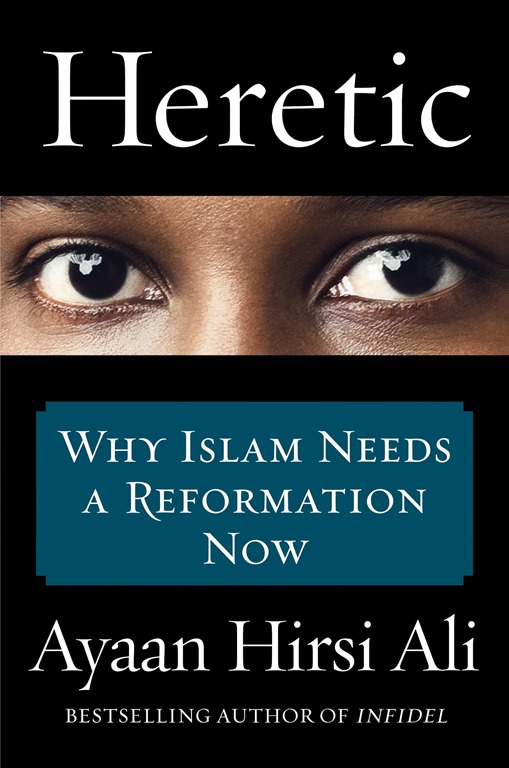
This summer, I read the political analysis, “Heretic:  Why Islam Needs A Reformation Now” by Ayaan Hirsi Ali.

Summary

As a self-described heretic and apostate, Ayaan Hirsi Ali long ago questioned the religion of Islam, in which she was raised.  Upon fleeing Islamic countries for The Netherlands, she received higher education in the more liberal Western culture and it was this that shaped her views that Islam was not only misogynistic, but also, doctrinaire as well.  In her writings, interviews and speeches opposing Islam, she has been met with many death threats.  Ultimately, she has arrived at the conclusion that the only way Islam can be fixed is by reformation – much in the same way as other major religions have undergone their own reformation over the ages. 

The author is of the belief that within Islam, there exists three types of Muslims:  The Medinas, The Meccas and The Modifiers.  She identifies herself as a Modifier – an apostate who cast doubts upon the religion in order for it to be reformed.  The Meccas – which is how the author was raised – are the peace-loving group that closely follows the rules of the religion.  The Medinas are the most problematic group because these are the ones who are the most violent and see the purpose of their religion as a political movement.  It is this group for which the book was written. 

Hirsi Ali then goes on to outline her own five-point plan of areas where Islam Reformation need to occur: 

  1. The Prophet Muhammad’s infallibility and the literal interpretations of The Qur’an
  2. The fact that life after death is valued much more than life before death
  3. Denunciation of Sharia Law
  4. Commanding “right” and forbidding “wrong” in order to enforce the religion  
  5. The importance of Jihad (holy war)

Review

It is simply undeniable that Ayaan Hirsi Ali, the author of “Heretic”, writes about her topic with passion, conviction and absolute sincerity.  Her wisdom borne out of a lifetime full of her own personal experience combined with impeccable research imbues this book with tremendous authenticity which makes this book worth reading.  Traversing from chapter to chapter, it’s nearly impossible to keep from nodding in agreement with just about everything this woman says because it all makes such perfect sense.  All of which makes the ending of the book so maddening.

The main problem with “Heretic” is the fact that it never explains either how or why this religion would ever seriously consider reformation.  Based on what we know and what we have seen from Islamic extremists, this appears to be totally against their nature; there is essentially nothing in the world that would motivate these people to consider reforming the religion, especially when you remember that these very same people want to live as though they are still in the 12th century (and also want everyone else to live that way).  It is this matter that seems a huge flaw in the logic behind this otherwise intrepid work.

If you are familiar with the background of Ayaan Hirsi Ali, you know that this woman is far beyond merely courageous; in fact, calling her courageous almost seems like something of an insult.  Therefore, it is painful to say that her optimism – Hirsi Ali’s belief that this reformation has in fact already begun – is naïve and lacks sufficient foundation.  Does she truly believe this herself?  Or was she convinced by her editor that she needed to have some semblance of a “happy ending” in order to sell more copies of her book?  It would be nice to think that Hirsi Ali is far too smart to fall for that.  

Thursday, August 10, 2017

“The Trip To Spain”– Movie Review

Spain

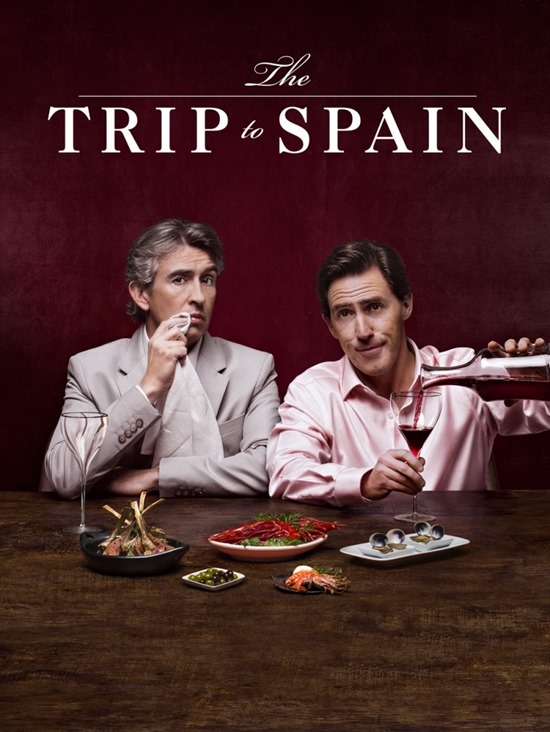
This week, I attended a New York Times Film Club screening of the new comedy, “The Trip To Spain” starring Steve Coogan and Rob Brydon.

Synopsis

When two long-time friends take an excursion throughout Spain, will the troubles in their personal life ruin their fun?

Story

Steve and Rob are hitting the road again – this time, to Spain.  Instead of going to all the major cities you might expect them to visit, Steve decides to literally take the road less travelled and check out some of the lesser-known locales.  The excuse this time?  The New York Times has hired Steve to do restaurant reviews and The Observer has asked Rob to do likewise.  However, Steve is planning to use this opportunity to start writing the book he’s been otherwise too distracted to write.  As might be expected from these two, the minute they set off on their getaway, both try to impress the other in how much they know about their destination.

Sensing they might be starting to get on each other’s nerves, they instead try to concentrate on the extraordinary food they’re experiencing at some of the best restaurants the country has to offer.  Along the way, they attempt to challenge each other with jokes and celebrity imitations; of course, they only wind up criticizing each other rather than simply allowing themselves to be amused by each other.  Only the fine meals they have appear to be what keeps them from breaking into fisticuffs.  By this point, it’s hard to believe that Steve actually invited Rob to accompany him.

When the two men are alone, they are forced to deal with the exigencies of real life.  With Steve, this means he’s lost his agent and the screenplay he’s been peddling is getting a polish by an inexperienced writer.  As if that isn’t bad enough, Steve’s girlfriend breaks up with him and his grown son, who was supposed to join him on the trip, bails out at the last minute.  For the happily married Rob, things are quite different; he’s being pursued by Steve’s ex-agent with promises of big Hollywood opportunities.  Growing increasingly homesick for his wife and children, Rob returns home.  Will Steve be able to resume his writing or will he be consumed by his own loneliness?

Review

A “silliot” is someone who is both silly and an idiot; don’t bother looking up the word, it’s totally made up.  In the best way possible, however, both Coogan and Brydon are the biggest pair of silliots.  When they share the screen, they are entertaining, informative and most of all very funny.  No doubt about it, it seems like it would be a ton of fun to hang out with these two, whether at a Michelin-starred restaurant in Spain or a dive bar in Brooklyn.  At least that’s true for most of the movie’s two hours; in the end, it takes a dark and rather disturbing turn.  

Much of “Trip To Spain” is a sheer delight, only occasionally broken up by more serious scenes that serve as each character’s subplots:  namely, the professional and personal life of both men.  For Coogan, it seems as though everything is falling apart all at the time time, whereas for Brydon, things couldn’t possibly be any better, both regarding his home life and career.  These subplots – and the way they are handled – are a useful device; without them, people would eventually grow tired of these men, if not find them both irritating.  The subplots serve to humanize them.

That third act is unsettling.  When Brydon returns home to his family, Coogan is left to work on his book; it is at this point, we see him melancholy without his friend around to distract him from his troubles.  Although Coogan is supposed to be writing, his brooding overcomes him, causing him to be blocked.  Was this the same movie we were laughing at earlier?  It comes across as a bit schizophrenic.  Without giving away the actual ending, it does come across as both unexpected not to mention startling.  One wonders if this is the final installment in the series.

The Trip to Spain (2017) on IMDb

Tuesday, August 08, 2017

“Ingrid Goes West”– Movie Review

Ingrid

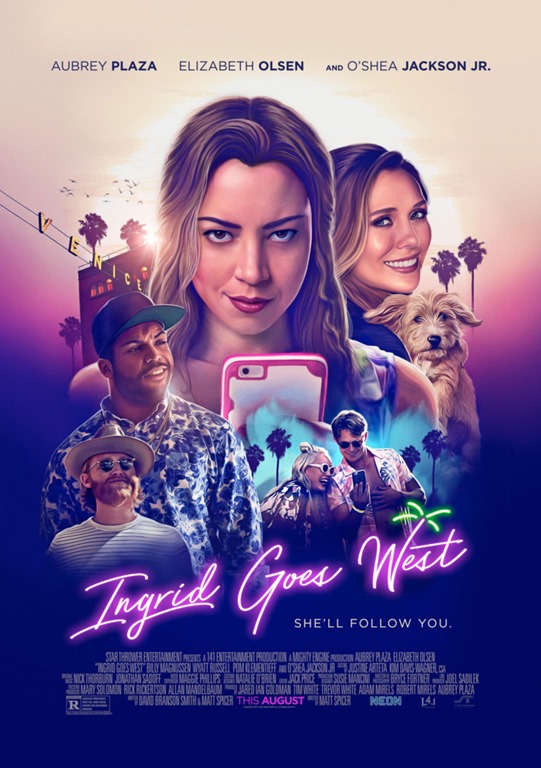
This week, I attended a New York Times Film Club screening of the new comedy-drama, “Ingrid Goes West” starring Aubrey Plaza (who also Produced) and Elizabeth Olsen. 

Synopsis

When a young woman stalks an internet celebrity, will they wind up being friends or will this celebrity find herself endangered?

Story

Ingrid (Plaza) is a lonely and isolated young woman -- which has led to some rather disturbing behavior on her part.  Since her mother’s death after a long illness, she has been using various social media platforms as something of a crutch; having a dearth of real friends, she has been “friending” a considerable number of strangers on the Internet and “liking” their posts or photos in a rote fashion.  The problem comes when Ingrid reads way too much into these “relationships”, believing that these people are actually her friends.  This ultimately results in Ingrid having a mental breakdown and she is committed.  

Upon Ingrid’s discharge, she returns to her late mother’s house where she tries to figure out how to continue with the rest of her life.  One day, she’s struck with what she believes is a brilliant idea:  while reading a magazine article about Taylor Sloane (Olsen), a newly-minted Internet celebrity, she starts following her on Instagram; after considerable online interaction with her, Ingrid finally gets a response from Taylor.  It is at this point Ingrid believes she’s forming a real connection with this woman and makes a decision that will irrevocably alter both their lives:  she will move to Venice Beach, California, where Taylor lives. 

Taking the $60,000 in cash she inherited from her mother, Ingrid rents an apartment from Dan (O'Shea Jackson Jr.), an aspiring screenwriter and Batman aficionado.  After finding out where Taylor lives, she uses some rather extraordinary and duplicitous means to meet and then befriend Taylor and her boyfriend Ezra (Wyatt Russell).  At the outset, they appear to be turning into the very best of buddies, at least until Taylor’s brother Nicky (Billy Magnussen) shows up; no model of stability himself, Nicky learns of Ingrid’s obsession with his sister and coerces her to keep him from revealing it to Taylor.  Ingrid’s reaction to this is to have Dan beat up Nicky.  When Taylor finds out what happened, she informs Ingrid their friendship is over.  Following a major meltdown, can Ingrid win back Taylor or will she have to find a way to move on without her?

Review

After screening “Ingrid Goes West”, one thing remains abundantly clear:  Aubrey Plaza can really play crazy … maybe a little too well … This movie has many laugh-out-loud moments, but it takes a sharp and very dark turn late in the story; despite this, the filmmakers are able to resurrect the humorous elements and the jokes eventually return.  Screenwriters Matt Spicer (who also directed) and David Branson Smith have concocted a very sagacious and unique script that hits the bullseye on cultural commentary in this era of social media – and more specifically, peoples’ obsession with social media. 

Curiously, this is a movie that may have a protagonist, but it lacks a hero; while it is obviously Ingrid’s story, this character is hardly heroic.  In fact, none of the characters in “Ingrid Goes West” are particularly likeable; Dan Pinto may come the closest, but given the fact that he deals coke on the side even he’s pretty shady.  Normally, all of this would result in an unwatchable film, but once again, the savior here is the comedy.  The relentless stream of jokes make this an eminently watchable motion picture.  You find yourself in a world that is simultaneously hilarious and frightening. 

If there is a criticism about this movie, it would be with respect to its ending.  Without giving away too much, the story’s resolution seems to suggest that Ingrid’s egregious behavior may have been rewarded.  This is dangerous as it could potentially be used as inspiration for further inappropriateness online (as if this society hasn’t seen enough already).  The motion picture apparently wants us to believe that its protagonist has suffered enough and as a result is now worthy of redemption.  Whether or not she is in fact worthy may depend on how you view her previous misdeeds.     

Following the screening, there was an interview with Plaza, Olsen and writer-director Matt Spicer.  Instead of attempting to summarize the discussion, a video of the conversation has been posted below (caution – it’s a half hour in length); the trailer for “Ingrid Goes West” is just beneath. 

Ingrid Goes West (2017) on IMDb

Wednesday, August 02, 2017

“Wind River”– Movie Review

wind-river

This week, I attended a New York Times Film Club screening of the new crime drama “Wind River” starring Jeremy Renner and Elizabeth Olsen.

Synopsis

When a rookie FBI Agent is assigned to investigate a murder on a Native American Reservation, will a local hunter be able to help her solve the crime?

Story

Winters in Wyoming are particularly brutal.  No one knows this better than game tracker Cory Lambert (Renner), a lifetime resident.  One day, he’s summoned to Wind River, the location of an Indian Reservation, where he’s asked to rid the community of a family of mountain lions which have been attacking (and in some cases killing) the steer that belong to the farmers there.  While following the paw prints of some animals, he happens upon an unexpected and unpleasant surprise:  the body of a young woman who has apparently died deep in the woods. 

After contacting the authorities, Lambert is introduced to Jane Banner (Olsen), a young FBI Agent who has been dispatched to look into the matter.  Before long, it is evident to all that her inexperience has her out of her depth.  Despite Banner’s severe disadvantage, she dutifully meets with the county Medical Examiner; after performing an autopsy on the deceased – an 18 year old, whose name was Natalie – the doctor informs Banner that although the woman appears to have been raped and badly beaten, her cause of death was actually exposure to the cold. 

Learning that Natalie’s boyfriend belonged to a crew of roughnecks working at an oil drilling site, Banner – joined by the local sheriff and his deputies – ventures out to the rig to ask some questions of the men there.  Panicking as they anticpate an imminent arrest, the roughnecks exchange gunfire with Banner, the sheriff and his men.  Banner is badly hurt and must be medevac'd out; when she tells Lambert that one of the roughnecks got away, he begins pursuit.  But can even a skilled hunter like Lambert find his prey in the vast snowy mountains of Wyoming?    

Review

Almost exactly one year ago, this Web site reviewed the movie “Hell Or High Water”; its screenplay went on to be nominated for both a Golden Globe and an Academy Award.  The writer of that screenplay was Taylor Sheridan, who both wrote and directed “Wind River”.  While this is not the first time he’s directed a film, it does mark the first time that Sheridan has directed his own screenplay.  It’s an impressive start for an aspiring auteur.  “Wind River” is both visually and dramatically a top-notch crime drama with solid action – some of which contains rather brutal violence (be warned).

Many of the same qualities that made “Hell Or High Water” such a compelling movie are visible in “Wind River” as well.  This well-crafted screenplay is buttressed by some fine acting from both Renner and Olsen, as well as Sheridan’s own directing.  He has chosen images that tell the story perfectly; in particular, the opening scene with Lambert where we see him protect a herd of sheep from a predatory pack of wolves.  It tells us exactly who Lambert is – both professionally and personally – as well as sets us up for the savage nature of the story. 

If there is a criticism about “Wind River”, it would be that late in its third act, it almost seems to be in a rush to fill in the gaps in its story so that viewers will fully comprehend the truth about what happened leading up to Natalie’s death.  On balance, while it does make the story more satisfying once we have this information, perhaps it might have been better to layer a bit at a time throughout the movie, with the big reveal coming at the end.  Granted, this might be quibbling on an otherwise deft script, which, we are told, was inspired by true events; its epilogue informs us that crimes regarding missing Native American women go severely underreported to the authorities.     

Wind River (2017) on IMDb