Thursday, June 16, 2011

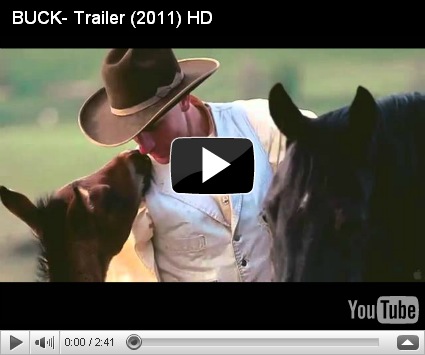
“Buck” – Movie Review


This week in my movie class, we saw “Buck”, a documentary about the life of Buck Brannaman, the real-life inspiration for the movie “The Horse Whisperer”. 

Story

Buck Brannaman is a remarkable man who has lived an equally remarkable life – and is also quite lucky to have survived the childhood he endured.  As a boy, he and his older brother Smokie were trained in roping and lariat twirling as taught to them by their strict father, who also got them both into performing their tricks publicly.  The two boys eventually became minor celebrities of a sort because of their skills – but what appreciative audiences never saw was the hellish private life of these young men who suffered cruel beatings at the hands of their violent father. 

Eventually rescued by a county sheriff who had both boys placed in a foster home, Buck was a bit aimless in life until he discovered a knack for working with horses.  After being awestruck by the performance of Ray Hunt, a legendary horse trainer out west, Buck ultimately went to work for him and learn all about the secrets behind making an errant horse compliant.  When Hunt passed, Buck took what he had gleaned during this time period and set out on his own to perform and help owners train their horses.  Along the way, he further refined his knowledge and as he gained more experience, added his own insights and techniques to the process.

As if by magic, we see Buck work with many different owners with various difficult horses and within a matter of minutes, somehow manages to transform a disobedient beast into an eminently trainable animal.  “I start out working with a human that has an animal problem and wind up helping an animal with a human problem”, as Buck characterizes his work.  He says that the main problem why horses aren’t trainable is because they don’t trust their owner – which mainly turns out to be the owner’s fault.  But when he tries to help an owner with a horse who suffered brain damage at birth, has Buck finally met his match? 

Review

Buck comes across as a man with subtle humor, deep wisdom and understated dignity.  Horses seem to respond to his quiet leadership because he respects them and is incredibly sensitive, likely due to the type of upbringing he experienced.  At no point in this story do you ever get the sense that the filmmakers are trying to pull a fast one on you – you buy into Buck’s undeniable gift and learn to appreciate him for the admirably gentle man he miraculously grew up to be. 

As far as the movie itself is concerned, the old show business philosophy of “keep ‘em wanting more” appears to be a driving force here as the film is kept within an hour and a half time frame – yet you are left desiring to see Buck continue on his cross-country trek not just because you’re fascinated by what he is able to accomplish with the horses, but because his complex concepts about the human condition are simplified in an articulate yet homespun manner which in turn allows us to learn and understand more about ourselves and each other. 

Both before and after the screening, Julie Goldman, the film’s producer, was interviewed.  She spoke at great length not only about the technical aspects of making this movie, but about some of the challenges she encountered along the way.  While the film is only 90 minutes, she wound up shooting over 300 hours in a period of over a year.  There were many things that were recorded but never used in the final cut of the movie, including some of the weirder characters Buck met during his travels.  It is hoped that some of this will wind up appearing on a “director’s cut”/outtakes version of the DVD when it is released someday. 
Saturday, June 11, 2011

Glass & Tools With Dale DeGroff


clip_image001

Recently, I had the good fortune to attend The Manhattan Cocktail Classic, held (obviously), right here in New York City. When I saw that one of the courses was being taught by the legendary mixologist Dale DeGroff – AKA The King Of Cocktails – I immediately signed up so I could (literally) learn from the master himself. The course was called Glasses & Tools where DeGroff would talk about the history of glasses used to imbibe adult beverages over the centuries, finishing with a lesson on how to use bar tools where students were invited to build cocktails at DeGroff’s direction.

DeGroff said that he learned very early on in his career as a bartender that very often, the glass will make the cocktail – something taught to him by a very difficult, demanding boss. Using the right glass, he came to understand, was an important ingredient in cocktail preparation – as important as any ingredient you would pour, muddle or sprinkle into the libation of choice. Historically, however, this was something that was not always understood or appreciated by most people – proved by virtue of the fact that nearly everything was served in a wine glass, regardless of what it was.

While original glasses really had more of resemblance to bowls than of glasses and were made of metal, the evolution of the cocktail glass started with the Phoenicians who were the first to use glass when they realized that glass could be made from sand. Over the centuries, the style was gradually improved upon by the Mesopotamians in 50 B.C. when they discovered glass blowing to make the glass in different shapes. Later, this was further refined by the Greeks and Romans. By The Middle Ages, Venice furthered the drinking glass during the period that came to be known as “The Age Of Enlightenment”. This was a significant turning point because they figured out how to add color to the glasses around the 15th century.

It wasn’t until the 19th century, however, that the cocktail glass was finally developed in the forms that we know them today. Although the glass makers designed their glasses in a way to reflect the ancient designers, they somewhat modernized both the form and technique for manufacturing, making the process less dangerous. As an example, the Venetian glass makers from an earlier time were forced to practice their craft on a remote island because it was feared that the factories where the glasses were made might easily go on fire and potentially burn down the entire city.

clip_image003

During this 19th century timeframe, the saucer style champagne glass – often known as a coupe – was originally developed. Interestingly, the original purpose of the design was to extend the surface area of the glass to get rid of the bubbles in the champagne so people would find it easier to drink. By contrast, as most folks already know, today, the preferred glass for champagne is a flute – a tall, thin glass with a very narrow surface area used precisely so that the bubbles in the champagne could be better appreciated.

Well, that’s about it for now. Do you have any interesting stories about the history of cocktail glasses? Or have you ever had “a brush with cocktail greatness” either with DeGroff or someone of his ilk? If so, then please post a comment and share it with the rest of us.

Thursday, June 09, 2011

“Page One” – Movie Review


This week began the June portion of the Summer Semester of my movie class and we screened the documentary “Page One: Inside The New York Times” .


Story

As many decades as The Gray Lady has been in existence, it has somehow managed to survive various obstacles – poor economic conditions, cutbacks of resources and scandals when the paper was in fact the news itself. In recent years, however, a new and unexpected challenge has emerged: the decline of the print media in general and the failure of many long-standing newspapers in particular. With the digital revolution in full force, many print outlets – including and especially The New York Times – have seen significant declines in their advertising revenue. As a result, they struggle to stay afloat.

For a number of years now, The New York Times has had a prominent presence on The Worldwide Web – the problem has been, however, that they have given away their content for free. Although they have always had advertisements on their Web site, the amount of revenue taken in from this has not offset the costs of providing the content. As a result, they have now instituted a new policy commonly referred to in the industry as a “paywall” – basically, a firewall that requires users to pay in order to acquire further access. You are allowed a limited number of free articles a month – after that, you must pay for a regular subscription to the site in order to see more.

In addition to that, layoffs and other cost-cutting measures have forced the paper to sometimes rework how they obtain and/or disseminate their news. For one thing, they have been cornered into making deals with some rivals – Web sites that supply content in digital form only. One of them has been Wikileaks; this is not a new concept – CNN did a similar partnership with Vice magazine to get their video content from http://www.vbs.tv/ . But will The Times’ subscription-based digital service generate enough revenue for the paper to sustain itself over the long haul or is their introduction of this policy a desperate last gasp that is merely too little and too late to save this legendary bastion of journalism?

Review

This movie is somewhat schizophrenic in the sense that while entertaining, it is also simultaneously a little scary. Regardless of your opinion of The New York Times, it seems that we might be in grave danger of losing serious professional journalism what with all of these newspapers going out of business. It almost appears as though the entire industry is waiting for The Times to figure out how to make a go of it simply so that they can copycat their business paradigm. While competition can certainly be a good thing, the rivals with whom you are competing might not necessarily be better, just different – and that is what’s attracting people to their Web site, especially among a younger demographic.

The clear star of “Page One” is David Carr, The Times’ Media Desk reporter whose fascinating background would never lead you to believe that he’d ever wind up as a reporter for this particular newspaper. He’s quite a character and depending on whether or not you like him, you may either find the movie has too much of him or too little. One of my misgivings about the movie is that it occasionally seems like something of a love letter to The Times; while they touch on certain scandals that have rocked the paper over the years, it would’ve been interesting if the filmmakers featured interviews with the likes of Jason Blair and Judy Miller to get a different perspective on things.

While the movie was enjoyable, the best part of the class was the interview prior to the screening – our instructor discussed journalism and the technological revolution’s impacts on it with legendary writer Gay Talese. Talese, a former reporter for The New York Times, is interviewed in the documentary. A number of years ago, he also wrote a book about The Times called, “The Kingdom And The Power”. Nearing 80, he reflected on his beginnings with the paper as a copy boy, then, after returning from the war, he was re-employed by the paper, but this time as a sports reporter. He said that his goal was never to write a story that appeared on page one of the paper because he preferred to be assigned to a story that would appear on page 30; he said that the advantage to this was the fact that doing so would give him a greater opportunity to focus on more human elements of a given story and reveal things that he would not ordinarily have the time or the space for if he were assigned to a page one type story.


Sunday, June 05, 2011

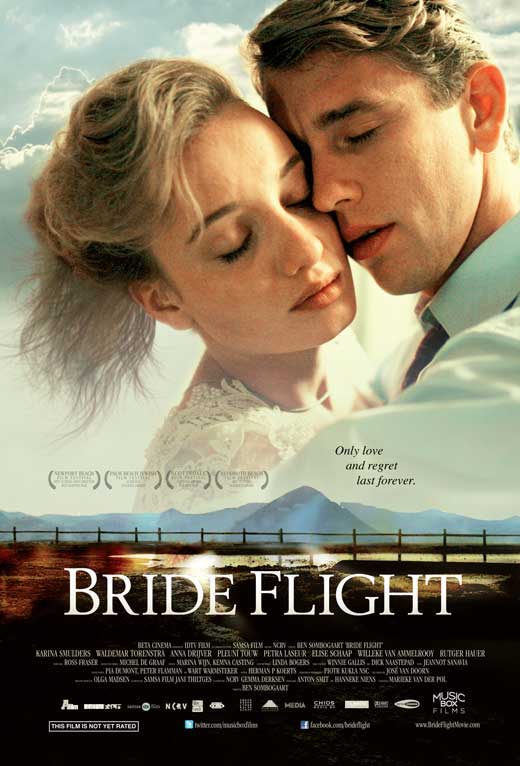
“Bride Flight” – Movie Review


This morning, the summer semester of my movie class began with a bonus screening of the Dutch drama Bride Flight – most of the stars are unknown to American audiences, but in a small (yet essential) role is Rutger Hauer. 

Synopsis
 
When several Dutch women emigrate to New Zealand to become war brides after World War II, their lives intertwine over several decades  in many different unlikely ways.


Story
 
In 1953, Holland has become a desolate, hopeless place in the years since World War II.  As a way of reinventing their life, a great many Dutch uproot themselves and move to New Zealand in the hope that their luck will soon change for the better.  Three young women meet on a flight to this new land and befriend each other, in addition to a devilishly handsome Frank – a few years removed from his college graduation, he is setting off to start anew as an agriculturalist in this country.  He quickly becomes friends with the other women, Marjorie, Esther and especially Ada – an especially lovely blonde; a powerful mutual attraction occurs immediately between Frank and Ada, but their romance will never be as she is off to live with her new husband – a man she felt compelled to marry as a way of comforting him after a profound personal loss … not to mention the fact that she is also now carrying his child.

Upon arrival in New Zealand, the four set out on their individual adventures.  But are they ready for what they will find?  Marjorie, eager to start a family with her new husband, has a miscarriage and is informed by her physician that she will never be able to have children of her own.  Ada’s husband is a deeply religious Christian who aspires to be an elder in the church; as a result, she is unfulfilled as a woman and despite having three children with this man, remains hopelessly in love with Frank, with whom, she has exchanged numerous billets-doux over the course of the subsequent years.  Frank has secured himself some land and sets out to grow grapes for the purpose of becoming a winemaker.  Esther, rejecting the homespun lifestyle of a wife centered around raising children to perpetuate Jewish traditions, decides upon a career as designer of women’s clothing. 

When Esther discovers she is pregnant, she arranges with Marjorie to raise the child as her own – however, over the years, tensions develop between the two women when Marjorie suspects that Esther has regretted her decision and now wants to insinuate herself into the boy’s life for the purpose of taking him from Marjorie.  Ada’s husband learns of the romantic missives, they fight and she winds up leaving him to stay with Frank.  With their romance rekindled, Frank now finds he must battle Ada’s husband if they are to stay together.  Decades later, the three women reunite at Frank’s funeral – but after all that has transpired over the years, can they somehow find a way to resolve their differences and resume a friendship?

Review

This is one of those movies that tends to jump around considerably in time and as a result, may occasionally be a little difficult to follow as a result.  The movie begins in the present day with a now elderly Frank (Rutger Hauer), having finally realized his dream of making great wine, dying in one of his vineyards shortly thereafter; it ends with the three women converged in New Zealand for his funeral.  In between, we see them at various points in their life, during the 1950’s, 60’s and 70’s.  Additionally, while some of “Bride Flight” is in English, much of it is in Dutch with English subtitles – in white, they are mostly surprisingly readable, except for a few scenes when they’re partially superimposed over some snow. 

As you may have surmised from the above, “Bride Flight” aspires to be a broad, sweeping epic of a movie and to a large extent, it succeeds at this.  But make no mistake about it – this romantic tale is a chick flick at its heart.  That said, however, I found it a little difficult to take due to its heavy reliance on melodrama – there are no happy endings, just as there were no happy beginnings or happy middles either, for that matter.  Despite the professional success for some, the personal life of these women seems downright miserable and depressing without any reason to believe it will improve any time soon.  The only character who seems to come out of this story relatively unscathed is the man – Frank – but then again, he’s also the first one among the movie’s central characters to succumb to his own mortality. 
 
The overwhelming majority of the class really enjoyed this movie considerably – including our instructor.  However, he did make one observation with which I completely agreed:  that this film will be a dismal financial failure, regardless of whether or not it gets glowing reviews.  One of the reasons for this is due to the fact that that it is, of course, a foreign film with subtitles and people generally don’t like reading at the movies.  But more to the point, the story focuses on a post-war event that was rather well-known and significant in Holland, but is relatively unknown in other areas of the world, including and especially the United States.


Tuesday, May 31, 2011

Spring Spirits Tasting


clip_image002

Every Spring, my favorite liquor store – Union Square Wines & Spirits – conducts a tasting of a vast array of spirits. This is one of the tastings I look forward to each year because in some cases, it introduces me to spirits I’ve never heard of before, or, in other cases, spirits I’ve heard of but have never as yet had an opportunity to try. In this blog post, I’m going to share with you some of the spirits I tasted which stood out to me this year.

Avion Tequila

If you’re a fan of the HBO TV show “Entourage” as I am, then you’re certainly familiar with Avion Tequila. They served a Blanco, Reposado and Anejo, all of which were 80 proof – and of course, from Jalisco, Mexico. According to the company representative, their tequila takes much longer to make than most others due to the fact that they use their own proprietary filtration process called “ultra slow filtration”. The unaged Blanco had a sharp bite on its finish. The Reposado is aged in oak barrels for anywhere from two to eight months and had a delightful smoothness to its taste. Their Anejo was aged two years in white oak barrels, formerly used to hold Jack Daniels whiskey – which is quite clear when you sample it as it’s got a particular smokiness to both its nose and taste.

clip_image004

Bache-Gabrielsen Cognac

Bache-Gabrielsen was not a Cognac I was familiar with, but I was immensely grateful for the introduction. They served us three offerings of 80 proof Cognac, including a V.S.O.P. and an X.O – each of which came from different regions and used different grapes. I started with what is called Three Kors, which had a fascinating background. The term Three Kors means Three Crosses; it is derived from a time when Norway had its prohibition period; at that time, spirits could only be sold by prescription in pharmacies – pharmacies, were identified by a sign which bore three crosses … hence the name. The V.S.O.P. had a bit of a spicier taste to it while the X.O. contained high acidity and had a considerably longer finish.

Michel Couvreur Scotch

While I might characterize myself as something of a Scotch aficionado, I would never be so presumptuous as to say I am an expert by any means. And so it was that I was introduced to yet another spirit new to me – Michel Couvreur Scotch. Their 12 year aged Malt Scotch is 86 proof and possesses a distinctive sweet smell, with a gentle taste that’s not especially overwhelming. The company representative described it as “rounder and more sophisticated”. Additionally, they served something called a Pale Single-Single that was 90 proof. Unfamiliar with the term “single-single”, I learned that this referred to the fact that the scotch was single malt and aged in a single barrel. This one had a more familiar Scotch feel to it as it had more burn on the back of the tongue, contributing to a long finish.

Have you ever tried any of these spirits? If so, please post a comment and share your experience with us.

clip_image007

Sunday, May 22, 2011

“Beautiful Boy” – Movie Review


This weekend, my movie class showed its final bonus screening of the Spring Semester, a drama titled, “Beautiful Boy”, starring Maria Bello and Michael Sheen.


Synopsis

A couple struggling with their marriage try to stay together for the sake of their teenage son – but when they learn that he’s been involved in a shooting at his college, will they be able to remain married?


Story

Bill & Kate (Sheen & Bello) are on the verge of divorce – the only thing keeping them from pulling the trigger is their beloved son Sam, a teenager struggling through his freshman year of college.  The couple’s only child, he is the sole focus of their attention when not directed at professional matters.  A shy, sullen young man, Sam seems disturbed in a complicated way that neither parent is able to easily detect in their communications with the boy.  Nevertheless, it comes as a shock to them when they learn that he has died in a shooting at his college – and even further disturbing when they are told that Sam was the one who conducted a massacre of students and faculty before taking his own life. 


Besieged by the media in search of the hottest new story, Bill & Kate flee their home to stay with her brother and his wife while they sort things out.  Ultimately, however, Bill & Kate begin to see that their presence is causing a strain in that couple’s marriage, too, so they leave in order to stay in a motel.  While alone, their focus turns to not only their son, but to the tragedy that he has wrought; each blames the other for the bad parenting that caused this situation, yet they also insist that they are free from complicity in the events that led up to this slaughter. 


Despite some bad memories, they are financially bound to return home – too many debts and creditors chasing them to be able to wallow in self pity for too long.  Finally, they are able to come to terms with the carnage and are able to go back to the house where they spent many years.  But once in their home, can they somehow manage to repair their marriage and return life to some semblance of normalcy? 


Review

Obviously, this is a difficult movie to watch – but not just for the reasons that seem to be immediately evident based on its subject matter.  There are technical reasons, as well.  For one thing, “Beautiful Boy” is shot in a very dark way, possibly the director’s choice to match its mood; as a result, the viewer must strain to see some of the scenes.  Also, the ending of the movie is a bit vague, which causes us to wonder what we are supposed to believe about this couple.  Perhaps the director didn’t quite know the story he wanted to tell or intentionally left the ending open to interpretation – in either case, it feels much like the work of an immature filmmaker. 

While the story is powerful and the performances by the actors match this compelling drama note for note, there are moments when the viewer drops out of the movie at various points.  Will the parents ever regain their sanity or are they forever destined to live in a state of high anxiety?  For much of the movie, we are forced to watch the couple react – or overreact – in a manner that seems unlikely and unbecoming.  Clearly, the actors chose these roles based on the portions of the script where they are allowed to exhibit their talents to their best display – which is fine, but the questions that are posed about such a tragic event are perhaps best left to be handled by a more experienced director. 

The instructor gave a little bit of background about this movie prior to the screening.  Director Shawn Ku – who also collaborated on the screenplay – was inspired to do this movie based on a tragedy in his personal life.  This is fine, but in order to tell a story such as this one, you must know where you want to wind up at the end, which, as I said earlier, is part of the problem with the film – it’s not quite sure exactly what it is that it wants to say about such an incident.  One of the more powerful scenes in this movie is the confrontation between the two parents when they are confined to a motel room; unfortunately, this is undercut by use of a handheld camera which seems to be intended to enhance the chaos, but instead, makes the scene almost visually painful to watch.  Fans of the singer Meatloaf should know that he plays a small role as the manager of a motel at which the couple stays. 


Thursday, May 19, 2011

“The Perfect Host” – Movie Review


The Spring Semester of my movie class concluded this week with a screening of the psychological thriller, “The Perfect Host”, starring David Hyde Pierce. 


Synopsis

After a bank robber scams his way into a man’s home to hide out, he tries to take advantage of him – but when the tables are turned, who will be the real victim?


Story

Injured during a bank heist, Taylor prowls an upper middle class neighborhood in a Los Angeles suburb looking to fool some unsuspecting rube so he can lay low for a little while and collect himself.  Looking to evade the police and eventually meet up with his girlfriend, Taylor happens upon Warwick’s (Pierce) house while he is in the midst of preparing for a dinner party.  Convincing Warwick that he’s an acquaintance of a mutual friend currently out of town, Taylor is permitted entrance to his home on the ruse that he has met with misfortune on his return trip. 

Suspicious of Taylor’s story, Warwick questions him about various details, resulting in friction between the two men.  Warwick decides to defuse the situation by inviting Taylor to stay for his dinner party – but when a news report about the robbery is announced on the radio, Taylor admits that he’s the one the police are after and then threatens Warwick’s life, forcing him to cancel his dinner party.  Soon, however, Taylor comes to the realization that Warwick has drugged him and that now it’s he who has become Warwick’s hostage, causing Taylor to fear for his safety. 

After being threatened with torture and possible death, Taylor somehow manages to escape from Warwick’s house – but has he escaped from his captor?  Warwick won’t allow Taylor the opportunity to get away scot-free.  Instead, he decides to put the squeeze on Taylor, coercing him in return for his freedom.  But will Taylor surrender to Warwick’s demands?  And will the police somehow manage to uncover the evil plot that both have hatched and executed?


Review


For David Hyde Pierce – Niles from the hit TV sitcom “Frasier” and star of many Broadway plays, including Monty Python’s “Spamalot” – his performance in the movie “The Perfect Host” can undoubtedly be characterized as a tour de force.  Appearing in almost every scene of the film, his vast acting talents are put on great display for all.  While much of this dark film is quite funny in its own twisted way, however, it is not without its own caveats – there are many contrivances and actions by its characters that force the viewer to suspend disbelief to the point that it feels as if that disbelief may in fact be a two-ton weight hovering precariously overhead, ready to drop. 

If you do choose to see this movie, make no mistake that it should be to watch Pierce’s portrayal of a psychopath the likes of which has rarely been captured on film.  Despite its shortcomings, “The Perfect Host” remains quite clever in terms of its many twists and turns – just don’t go into it with the expectation that you’re going to see something akin to the genius of Hitchcock.  In my movie reviews, I assiduously avoid including spoilers, despite the temptation; please believe me when I tell you that this is one of the more difficult reviews I’ve had to write in a long time because it is so ripe for spoilers.  You’ll just have to see the movie for yourself in order to appreciate that.  By the way, an actor by the name of Clayne Crawford plays Taylor and you’d swear he was a dead ringer for Ray Liotta.  And will you be able to recognize the cameo appearance by the 1970’s singing sensation Helen Reddy?

Following the screening, our instructor interviewed the star of the film, David Hyde Pierce.  Pierce spoke at great length about his background, saying that he started out studying at Yale with the hope of someday being a musician; however, after taking an acting class, the teacher and the experience inspired him to take his life in a different direction.  While he has had great success in television, Pierce claims that his love of working on the stage prevents him from wanting to return to starring in a regular TV series at any time in the near future – although he clearly refused to rule it out altogether. 


Saturday, May 14, 2011

The Gift Of The Agave


clip_image001

Recently, I attended a tasting during the week of Cinco de Mayo where agave-based spirits were featured – these of course included both tequila and mezcal. The tasting featured eight types of mezcals from two different manufacturers and a total of ten types of tequila from three manufacturers. Try as I might, I was unable to taste every single one due to a shortage of both time and sobriety. As a result, this review will focus on sharing with you some of the ones I thought were among the best. These will include two mezcals from different manufacturers and several offerings from one tequila manufacturer.


Fidencio

Fidencio Joven Mezcal was the first mezcal I tasted on this day. An 80 proof spirit from Oaxaca, Mexico (as were all the mezcals), this is somewhat less smoky than a typical mezcal because of the difference in its preparation. While mezcal production is typically made by roasting the agave with mesquite, Fidencio instead uses radiant steam heat to cook the agave plant without the inclusion of mesquite. The result is a less intense and more accessible mezcal which might be a good choice for someone to try as an introduction to the spirit. We tried it in a cocktail called The Mule Variations, which had the following recipe:

  • 2 oz. Fidencio Mezcal Sin Humo
  • ½ oz. fresh squeezed lemon juice
  • 2 dashes Peychaud’s Bitters
  • Topper of Ginger Beer

Combine all of the above ingredients (except for the ginger beer) in a mixing glass with ice, then shake to chill. Strain into a rocks glass with fresh ice, then top it off with the ginger beer. If you prefer a sweeter taste to the cocktail, then substitute the ginger beer with ginger ale; this was used in the version of the cocktail we tried because they couldn’t find any ginger beer.


Del Maguey

Next up was Del Maguey, arguably the best mezcal – and they’ve won enough awards at various spirits championships over the years that they could probably take that argument handily. They presented seven different types of mezcals to the tasting, ranging from 80 proof to a whopping 98 proof. Despite the fact that I wanted to sample them all because of their reputation, I restrained myself to only a couple in order to remain vertical for the remainder of the day. Without a doubt, these are all very much sipping mezcals (the company strongly recommends you do not use them as shots), however, their first one – the 84 proof Del Maguey Mezcal Vida – is the type they say could best be used for mixing cocktails because it doesn’t have a taste that will overwhelm the drink.

My own personal favorite, however, was the Del Maguey Chichicapa Single Village Mezcal. At 92 proof, this one immediately caught my attention because the company representative described it to me as The Laphroaig of Mezcals. Seeing as how Laphroaig is my favorite scotch, I had to give it a try and I was far from disappointed. Although served in small clay cups for the tasting, you’d easily want to sip this from a nosing glass because of its fragrant aroma. Its strong smoky taste is particularly apparent on the finish. I highly recommend this one.


agave_menu1

Siete Leguas

If you are a fan of Patron, I can almost guarantee you that you will immediately switch to Siete Leguas once you have given it a try. It is so flavorful that you might almost consider Patron to be bland after you’ve tasted Siete Leguas. For those of you who may be unfamiliar with this particular tequila, please allow me to share with you a rather colorful story about its background – which will help to clarify exactly why I made the Patron comparison at the outset.

Let’s begin with the name: Siete Leguas means “Seven Leagues”. The reason why it is called Siete Leguas is because that was said to be the name of Pancho Villa’s horse; Villa supposedly named the horse Siete Leguas because it ran an impressive 21 miles (7 leagues) during a conquest. Siete Leguas has earned the nickname of “The Original Patron” because for many years, they made the tequila that was sold by Patron in the United States; they did that because Siete Leguas was not sold here and Patron wanted to market themselves in this country. Over 20 years ago, the two companies had a falling out which resulted in Siete Leguas no longer providing the tequila for Patron – but now that Siete Leguas is sold here in America, they are in direct competition with Patron.

The distributor let us sample the blanco, resposado and añejo, all of which were 80 proof. The cocktail that was mixed with the reposado tequila was something called The Natural Margarita because of its ingredients:


  • ½ oz. of agave nectar
  • ¾ oz. water
  • 2 oz. Siete Leguas Reposado Tequila
  • 1 fresh lime juice
  • 1 oz. Gran Gala

The last ingredient, Gran Gala, is an orange flavored liqueur similar to Grand Marnier. All of the above are shaken then strained into the glass (with or without ice, depending on your preference). In trying this version, we found that the other ingredients somewhat masked the flavor of the tequila, so the recipe was changed to instead use 3 oz. of the tequila, which made the cocktail both better and stronger.


Have you tried any of these? If so, please leave a comment and let us know what your experience was like.


agave_menu2

Friday, May 13, 2011

“The First Grader” – Movie Review


This week in my movie class, we saw the drama “The First Graderstarring Naomie Harris.


Synopsis

After the Kenyan government promises its citizens a free education for all, an 84 year old man applies to be a student in an elementary school – but when his attendance causes controversy, both his future education and his teacher’s job are in jeopardy.

Story

In the years after the Kenyan revolt against British colonialism during the 1950’s, the life of almost every citizen of that country changed – mostly for the better. One of the benefits that resulted from gaining their independence was the fact that the government provided free education to all citizens. When this became available, parents bombarded the few tiny schoolhouses nearest their village to enroll their children in grade school – but there was one student that no one expected. His name was Maruge, an 84 year old veteran of the Kenyan uprising who has been functionally illiterate his entire life.

After multiple rejections, Jane (Harris) – the teacher at the school – finally decides to accept Maruge as a student, in part due to his determination to learn. With Maruge enrolled, he begins to soak up each new lesson like a sponge and quickly becomes one of the best students in the class, even offering to help some of the other children who are slower to learn. Soon, he makes friends with many of the students, who are young enough to be his grandchildren, if not great-grandchildren. But Maruge’s enrollment comes at a cost – his presence causes both controversy and notoriety when the media learn of his existence and descend upon the school to cover this story. Many parents resent Maruge being there because they feel that their child is being slighted due to the shortage of resources at the school.

Following a review of the situation by the Board of Education, it is decided that Maruge can no longer be a student at the school. Disappointed that his education is terminated, Jane decides to circumvent the matter by making Maruge an unpaid assistant, to whom she will provide special one-on-one lessons at the end of the school day once the children have all gone. But once the administration learns of this, their response is to not only expel Maruge but also, to transfer Jane to another school far away. Traveling into the city, Maruge crashes a meeting with the administrators to plead his case – but will he succeed in being reinstated as a student at the school as well as get Jane returned to teaching there?

Review

This movie is based on a true story, which, at its essence, is very inspiring and serves as proof of both the appreciation and value of an education. Having said that, however, it’s also certainly not for everyone – as evinced by the fact that there were several students who walked out of the screening. Most likely, this is due to the violence – the story of Maruge and the history of the revolution of which he was an essential part is told at various points throughout the film in a serious of flashbacks. While you don’t see gore in certain of the scenes, the violence is implied; some scenes include brutal execution of women and children and bloodshed as the result of torture when Kenyan prisoners are whipped at the hands of British soldiers. Even some of the students that did not walk out wound up averting their eyes at these scenes, so take that caveat for whatever you feel it may be worth.

Although ultimately an uplifting tale, I had some problems with the way in which the story was told. For one thing, certain things were handled in a rather heavy-handed manner; this would include, but definitely not be limited to, the violence; as much as certain characters may be beaten, we, as an audience, also feel beaten over the head with returns to such scenes. While it’s understandable that the filmmaker’s intention is to get the audience to appreciate the extent of the suffering Kenyans faced during this time, eventually, you just want to respond by saying, “OK, we get it, let’s move on now, shall we?” Another issue for me was the fact that the main character who was supposed to be the focus of the story seemed to turn a bit at the end of the second act. To me, it seemed to change from being Maruge’s story to being Jane’s story. This made for a slight feeling of imbalance, but one that you may be ultimately able to correct, depending on how much you buy into the film in the first place.

After the screening, the instructor interviewed one of the film’s producers as well as one of its stars, Naomie Harris. The producer said that he had originally gotten the idea for the movie when he read an article about Maruge; he then set out to purchase the rights to Maruge’s story and after a few weeks, was all set to start working on the movie. Originally, the producer said he wanted Morgan Freeman to play the part of Maruge, but Freeman turned down the role because he felt that it should be played by a lesser known actor. The producer then sought out Sidney Poitier, who declined because he refused to come out of retirement. Eventually, they wound up hiring a retired TV newscaster local to the area. Harris said that she felt comfortable with this role because her father was a teacher and she grew up in that environment. She said that he was of great assistance to her during the shooting of the movie when she found that some of the children were not responding to her; he then gave her some advice, at which point they started to come out of their shell a bit.


Sunday, May 08, 2011

“How To Live Forever” – Movie Review


This weekend, my movie class had a bonus screening of the documentary “How To Live Forever” by Mark Wexler. 


Synopsis

A documentarian turns his camera on longevity, asking elderly people how they managed to live so long and posing the question how long do we want to live?


Story

Documentary filmmaker Mark Wexler was inspired to make this film several years ago when he received his AARP card in the mail shortly before his 50th birthday.  A watershed moment for him, this basically stopped him in his tracks because it forced him to come to the realization that not only was he aging, but also, he had to confront his own mortality.  It was with this in mind that he wondered about exactly how long he wanted to live.  Did he want to live forever?  What does it take to live a long life?  Could he thwart his own genetics to live to be over 100? 

Opening at a mortician’s convention in – of all places! – Las Vegas, we see the many technological advances that have been introduced to the profession for how to best deal with death.  This then immediately raises the question about when should death be expected?  We’ve seen people die in their 70’s or 80’s and believe that they may have lived a long, full life, but is that really something which we should consider a long life?  What is called into question here is the aspect of longevity – what is it and how to reach it?  Certainly, we like to think that we know this, but are the so-called “Baby Boomers” ready to go softly into that good night? 

Wexler winds up traveling not only throughout the United States, but around the world as well.  In his travels, he finds that Okinawa, Japan has many residents in their 90’s and even over 100 years of age – as a matter of fact, one of these women proposes to him!  What makes these people live so long?  Well, for one thing, it’s certainly their low-calorie diet, but for another, it’s their level of activity – not merely physical exercise, but also, mental activity as well.  These people have something to live for, something that makes them want to wake up and get out of bed in the morning – they are mentally, spiritually and physically fully engaged in their own life.  Among the people he meets is a 75 year old Japanese porn star!  In England, he meets Buster – a man who believes that a steady job leads to a stead life.  Buster, like some of the people Wexler meets, drinks, smokes and does other things that contradict his so-called “healthy” life – yet, they have lived for many years.  Is Wexler’s traditional concept of a healthy lifestyle wrong or are these people merely some kind of mutants?  


Review

Mark Wexler is the son of acclaimed Hollywood cinematographer Haskell Wexler.  Raised believing his father was a film icon, he made the documentary “Tell Them Who You Are” as a tribute to him.  Likewise, you could say that Mark Wexler made “How To Live Forever” to similarly pay tribute to his mother, an equally talented artist, whose paintings burned in a house fire years before her death – but in a strange way, contributed to her mental and emotional downfall which ultimately resulted in her death.  Was this what the filmmaker was trying to tell us?  Is intellectual engagement in life the most vital thing to living a long life?

While it might be so, Wexler’s documentary vacillates between actual documentary and sometimes mockumentary that it sometimes may be hard to tell whether or not it should be taken seriously.  Although the film is at times genuinely funny, it is also equally as sad because occasionally, some of the interviewees cannot quite grasp exactly what it is that has allowed them to live so long and – in some cases, at least – live so productively.  Periodically, Wexler turns the camera on himself in what appears to be comic attempts that sometimes succeed, but not consistently enough to merit calling this film a complete success. 

Both before and after the screening, Wexler was interviewed by the instructor.  Although personable, he is not humorous enough to cause genuine, spontaneous laughter in his discourse, which was a telltale downfall in his documentary.  At times, the film seems to want to take itself seriously by interviewing scientists, writers and physicians – yet it is somewhat schizophrenic in the sense that it also appears to wish to strike humorous tones, which results in its ultimate message to be somewhat muddled.  Wexler spoke about how his experience making this film caused him to make certain changes in his own life and also talked about some of the subjects in the film and how life after the shoot went for them.