Thursday, April 19, 2018

“Love, Gilda”– Movie Review


love gilda

This week at the opening night of The Tribeca Film Festival, I attended the World Premiere of the new documentary, “Love, Gilda”. 

Synopsis

A documentary that covers the life, loves, influences and premature death of a beloved comedy actress from the original cast of “Saturday Night Live”.

Story

Detroit in the 1950’s was a special place to grow up.  It was among the best and biggest cities in America – known as The Motor City because it was the home to automobile manufacturing.  This is where Gilda Radner grew up.  Born into a family of means – her father was successful in real estate – she was a child who came late to her parents, born when they were around 50 years old.  It was therefore a traumatic event when her father passed away when she was only 14; she believed that because he died before she became a woman, she subconsciously wanted to remain a child forever after. 

During her childhood, Gilda was a bit on the chubby side, which caused her to be the focus of much ridicule from her classmates.  She would use her sense of humor to turn this into a defense mechanism to combat her bullies.  When she went off to college, she joined a theater group and fell in love with being on the stage and acting.  Realizing early on that comedy was where she was best suited, she joined a comedy group where she could perform sketches and perfect creating her own characters.  Later, she would get her first major job in the musical“Godspell”, which led to her joining Toronto’s Second City comedy troupe. 

Her big break came when she passed an audition in 1975 for a new television show called “Saturday Night Live”; becoming a cast member, it was not long before she was recognized as one of the show’s stand-out performers.  Leaving the show a few years later, she embarked on a career in the movies; one of those introduced her to Gene Wilder, whom she would later marry.  Their short-lived union seemed doomed when Gilda was diagnosed with ovarian cancer; after initially going into remission, the cancer eventually resurfaced and she died in 1989 at the age of 43. 

Review

For fans of either Gilda Radner or of the original Saturday Night Live, “Love, Gilda” will be something of an emotional roller coaster; as much of a joy as it is to see Radner’s appearances on old video clips, it’s painful to see her getting sick towards the end, especially when we know the outcome.  Likewise, learning about the emotional pain in her personal life is equally difficult -- although it did help to shape much of her later work and some of the characters she subsequently developed on the television show. Nevertheless, the eating disorders she suffered from even after attaining professional success show that her fame didn’t really bring her the happiness she sought.

Among the delights of this documentary is the fact that there are a great many home movies that are included -- not only from Radner’s childhood, but also later in life, including when she became ill.  One of the most notable omissions is among the interviews of people who knew her; Wilder, of course, passed away a couple of years ago, but her first husband, guitarist G.E. Smith, was absent as well. Was he difficult to get in touch with or have his scars never healed?  Also, some former SNL cast members were missing in action. Paul Shaffer and Chevy Chase appeared in the film, but Dan Aykroyd (one of her former boyfriends) were nowhere to be found.

One observation -- which is not necessarily a criticism, but something worth noting -- is that the style of this documentary will seem very familiar if you’ve already seen Judd Apatow’s documentary on HBO, “The Zen Diaries Of Garry Shandling”.  The reason is because “Love, Gilda” -- like Apatow’s film -- incorporates the actual diary entries of its subject. In both documentaries, some are just seen on screen and others are read aloud (in the case of “Love, Gilda”, they are read by former SNL cast members who succeeded Radner’s era).  Oddly coincidental as well is the fact that the documentary also includes Radner’s return to television after cancer treatment: an appearance on the late Garry Shandling’s Showtime sit-com.

Love Gilda (2018) on IMDb

Sunday, April 15, 2018

“Bloodlight and Bami”– Movie Review


gracejones

This weekend, I attended the opening of the new musical documentary “Grace Jones:  Bloodlight and Bami”, starring Grace Jones. 

Synopsis

A documentary where Grace Jones is seen performing live in concert and in behind-the-scenes visits with her family in Jamaica.

Story

Performer Grace Jones travels to her home – the island nation of Jamaica – where she spends time with her family.  In these moments, this woman with the bigger-than-life personality becomes suddenly humanized; she is less the celebrity and more the dutiful daughter, sister and aunt enjoying down-time with relatives she has not seen in a very long time.  At times, it seems as though she is less having a family reunion than acting like a tourist; Jones visits various attractions and takes occasional snapshots of the surroundings and people.

While promoting her latest recording, a disco version of “La Vie En Rose”, she goes to Paris in order to appear on a television show where she will perform the song.  Unknown to her, the set is designed in such a way where she will be surrounded by young women dancing in lingerie.  Following the taping, she argues with the show’s producer that she feels as though she looks like either a pimp or a Madame who operates a brothel.  The producer, wishing to appease her, offers to let her re-tape the segment without the dancers. 

At this point in her career, Jones suddenly finds herself without a recording contract.  As a result, she must coordinate her own recording sessions if she is to make the new album she wishes to start.  What this means is that she will have to pay for the recording studio and musicians out of her own pocket and hope to get reimbursed either by sales of the album or concert appearances.  Unfortunately, some of the musicians she has lined up turn out to be unreliable and fail to arrive for a scheduled recording date.  Desperate, Jones must either convince them to join her or find new musicians on short notice.    

Review

Once upon a time, there was a big problem with documentaries:  it was called The Talking Heads Syndrome.  This problem was manifested by rapid cuts to a blur of many different faces in close-up, each of whom were being interviewed about the subject of the documentary.  There was very little intercut between the interviewees and other footage or even still photographs.  As a result of this, many people got turned off to watching documentaries because it felt more like a lecture than a film.  While there is little to no justification for going back to this style of filmmaking, “Bloodlight And Bami” might have benefited from a prudent amount. 

Not unlike Grace Jones herself, this documentary is pretty much all over the place.  There is precious little in the way of context or explanation for exactly what we are seeing and who we are hearing from throughout the film.  That’s unfortunate because there seems to be plenty interesting there that is alluded to about Jones’ past and what she’s experiencing now in the present.  Although it frequently intercuts between performances and personal time with her family, it’s not really biographical; we learn nothing about her acting career and never see clips of her many movies. 

Following the screening, there was a question and answer session with Jones and the film’s director, Sophie Fiennes.  Fiennes said that she met Jones at a screening of one of her other documentaries in 2003; they hit it off and decided to work together on something.  Shortly thereafter, shooting started and occurred sporadically over a period of years in between other projects with which each were previously occupied.  Jones revealed that one of her greatest professional regrets was the fact that she turned down a role in the original version of the movie “Blade Runner”; after reading the script, she abruptly changed her mind – but by that time, it was too late as the role had already been re-cast.     

Grace Jones: Bloodlight and Bami (2017) on IMDb

Sunday, April 08, 2018

“Hale County”– Movie Review

Hale County

On the closing weekend of The New Directors/New Films Festival, I attended the New York Premiere of the documentary, “Hale County This Morning, This Evening”. 

Synopsis

A documentary that follows the day to day activities in the lives of members of the Hale County, Alabama community.

Story

Hale County, Alabama is not the place where you’ll find the 1%; it has long been a town where poverty has reigned.  Over the decades, however, the demographics have changed; where it once housed white sharecroppers from the Dust Bowl era of The Great Depression, it is now home to African Americans who see little hope for a better tomorrow.  Instead, they just seek to find a way to survive day-to-day – which is no easy task.  The lack of opportunity for both the children and adults seems to be what dooms them to a future similar to their present.

RaMell Ross was living in Washington, D.C. when he had a job offer to move to Hale County where he would teach photography and help coach basketball.  Upon moving there, he found that he fell in love with the people and the place and instead of making this a short-term opportunity, he decided to settle there.  Inspired by the resiliency of Hale County’s citizens in the face of great adversity, he then decided to record their lives as they struggled to make a go of things.  Whether observing a basketball practice or watching children play with fireworks in an empty lot, he shot whatever he stumbled upon. 

Ross follows the story of one couple who, despite being of modest means, decides to have children.  After their first child, Boosie later becomes pregnant with twins; she has a boy and a girl.  Tragedy strikes when the boy succumbs to Sudden Infant Death Syndrome, leaving the couple now with only two children.  In the stiflingly humid summer heat, there isn’t much in the way of entertainment for many children but to spend evenings outside hoping for either a soothing breeze or a rain to cool things down.  In Hale County, the citizens become accustomed to living in invisibility.   

Review

For those who seek a standard narrative structure in a documentary, “Hale County, This Morning, This Evening” will not be your movie.  That is because this documentary has none – the structure is as flat as a pancake.  Whether or not that is a good thing or a bad thing will depend on the degree to which you respond to director RaMell Ross’ unique visual style.  There is no doubt about the fact that he has done something quite different in terms of not only his shot choices and composition, but also the fact that he’ll choose to linger on a particular shot merely because he finds it interesting. 

There is no doubt about the fact that Ross is quite courageous – some might even say audacious – to attempt something quite so daring in your first feature film.  However, there is also the extremely valid question of whether or not it works.  One can look at pretty pictures for only so long before it feels as though you’re merely watching someone’s home movie rather than a documentary.  We have to get an understanding of whose story we’re watching, why it’s being presented to us and for what reason should the audience have an emotional investment.  While this is not an argument to contrive a story that doesn’t exist (a sin of some documentarians), all filmmakers must be capable of telling a story coherently.

Following the screening, director RaMell Ross was interviewed.  The full title of the film, “Hale County, This Morning, This Evening”, was a nod to writer James Baldwin’s short story, “This Morning, This Evening, So Soon”.  Ross said that he shot the movie over a five year period, recording over 1300 hours of footage.  He found it to be a bit of a challenge to raise money for this movie because investors didn’t like the fact that there was no story.  Instead, Ross believed in the documentary’s ability to show beauty in the mundane – a “rambling beauty”, as he characterized the content.    

Hale County This Morning, This Evening (2018) on IMDb

Sunday, April 01, 2018

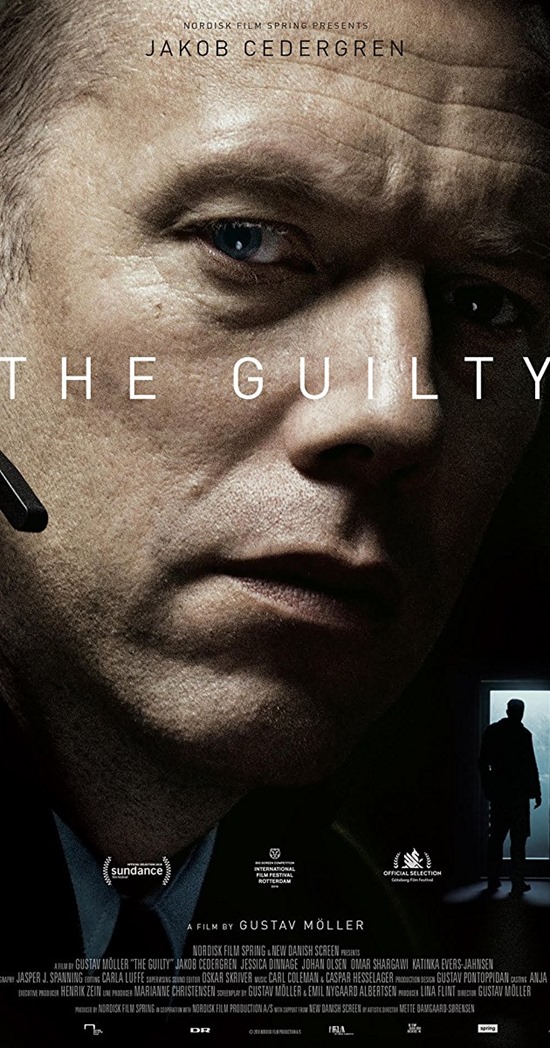
“The Guilty”– Movie Review

Guilty

This week at The Film Society Of Lincoln Center’s New Directors/New Films Festival, I attended a screening of the Danish suspense thriller, “The Guilty”.

Synopsis

When a police officer is forced to serve duty in emergency services as punishment, will he be able to help solve a crime and, in so doing, attain redemption?

Story

Copenhagen Police Officer Asger Holm isn’t terribly pleased that he’s ordered to perform emergency services duties; he’d much rather be out on the street solving crimes.  But given the fact that he and his partner Rashid have been accused of unnecessarily shooting a suspect, Asger is just grateful to still be on the police force – at least for now, anyway.  A hearing is about to be held as part of the police’s internal investigation of this situation; both Asger and Rashid know the truth, but their plan is to provide the investigators with a story which will exonerate them both.

Bored on a typically slow night, Asger gets a call that finally gets his attention:  Iben calls emergency services to report that she’s been abducted by her ex-husband, Michael.  Since Michael is with her at the time of her call, she has to be very careful in the way she speaks to Asger for fear that Michael will figure out what she’s doing.  Asger contacts the local dispatcher to send a patrol car out to pull them over, but given that the only identification available is that the couple are in a white van, they will be hard to locate.  Asger finds he needs to utilize all of his policing skills in order to rescue Iben. 

Eventually, Asger is able to conduct some necessary research to try to get more information about Iben and Michael; he discovers Michael has a criminal record and has been done time.  Realizing he’s dealing with a potentially dangerous person, Asger has a police car dispatched to Iben’s house in order to look after the children that were left behind – six year old Mathilde and her younger brother Oliver, an infant.  Good police work uncovers more information about the couple – but when Asger learns disturbing news that alters his perspective, how will this impact solving the crime? 

Review

Normally, if you were told that an entire movie’s action takes place in a single set and all of the dialog is entirely on the phone where you can’t see the other people, your reaction would understandably be underwhelming.  There are, however, occasional exceptions to the rule and “The Guilty” is most definitely one of them.  This is a film that reaches a suspenseful level early on and maintains that degree all throughout – a tough thing to do, but director Gustav Möller somehow manages to pull it off brilliantly.  Through his directing and editing choices, we experience the taut drama exactly the way Asger experiences it, grabbing our attention and not letting go.

Sadly, what must be noted is the timeliness of this movie.  In recent days – specifically, the Stephon Clark shooting – we have been reminded of the excessive savagery by the police.  Ironically, Asger is being investigated for the exact same thing – thus his being taken off the street and required to perform emergency services duty until the investigation has been completed.  He and his partner Rashid are planning to lie about what happened in order to avoid further consequences.  While the audience is aware of this, we are also aware of the fact that this same officer is trying to help solve a crime.  That is also part of the cleverness of the film – the fact that good and evil is not always a simple black and white issue.

Following the screening, there was an interview with director Gustav Möller, who also co-wrote the screenplay.  He said that this was a 13-day shoot and it was all done in chronological order.  In editing, much was cut out in order to maintain the pacing of the movie, which is vital to its success in storytelling.  Möller’s greatest influence was the first season of the podcast “Serial”, where you were forced to paint a picture of the characters in your mind and the more information you got about them, the more your perception of them changed.  Möller had no rehearsals – only table reads.  This was done in order to keep a fresh feel throughout the shoot.

The Guilty (2018) on IMDb

Thursday, March 29, 2018

“Matangi/Maya/M.I.A.”– Movie Review

MMM

On the opening night of the New Directors/New Films festival, I attended the New York Premiere of the documentary, “Matangi/Maya/M.I.A.”.

Synopsis

When singer M.I.A. becomes an outspoken political activist about her homeland in southern Asia, what impact will it have on her career?

Story

Before M.I.A. became an internationally famous rap/hip-hop performer, she was a little girl named Maya.  Born in Sri Lanka, her family moved to England in order to escape the political upheaval that came when an increasing group of resistance fighters known as The Tamil Tigers made living in Sri Lanka a growing challenge.  One member of her family did not accompany her to England, however – that was her father, who was the founder of the Tigers. He stayed behind to not only fight with them, but to train new recruits who wanted to join them in their opposition to what they experienced as an oppressive government. 

With the freedom to grow up in England, Maya could now further pursue her love of music.  Not only did she enjoy singing, she was also capable of writing her own songs. An established music producer learned of her talents and soon wanted to work with her.  Maya began recording a few songs for him and upon their release, people responded favorably. Shortly thereafter, her success in the music industry was well underway; Maya – who eventually became known as M.I.A. – not only started recording more but also gained greater visibility by performing in larger venues.  It wasn’t long before her fame reached the United States and she eventually moved to Los Angeles when her career really took off.

Eventually, M.I.A. started showing up on Madonna’s radar and the two occasionally worked together.  M.I.A. created a bit of a controversy when Madonna invited M.I.A. to join her in performing during the halftime show of the Super Bowl.  At one point, M.I.A. looked directly into the camera and gave the finger to viewers; she suffered enormous criticism as a result of this, especially in the conservative media and throughout middle America.  To add to her grief, the NFL didn’t exactly take kindly to her behavior either – for her little prank, they decided to sue her for more than $16 million. 

Review

If you are planning to see Matangi/Maya/M.I.A.”, it isn’t at all necessary for you to know who the Tamils are as a prerequisite, but it certainly does help.  The reason why it helps is because M.I.A. does such a poor job of telling a story that’s not directly about her that she either can’t or won’t educate the audience; it’s almost as if she’s assuming you know who they are and what their plight is – and if you don’t then you don’t matter.  It seems that on a certain level, she wants to tell their story but not really – she’d much rather tell you about herself because apparently she’s convinced that she’s the most fascinating mammal on the planet.

What doesn’t help is the fact that MIA’s father, the founder of Sri Lanka’s Tamil Tigers, is perceived by some as a terrorist.  With that information, it becomes something of a challenge to root either for her or her cause. Despite the fact that the cause for which the Tigers are fighting may indeed be a valid one, they use violence to make their point, forcing the Sri Lanka government to respond in kind.  Keeping that in mind, it is no wonder that a war which started in 1983 didn’t end until 2009. Which also raises another question:  Why is M.I.A. still so consumed with this all these years later? Did it inform her music? Hard to know since the lyrics are largely indecipherable.  

Based on what we see in this documentary, M.I.A. is less consumed with political activism than she is with herself.  She apparently considers herself a genuine bad-ass and seems to want to go out of her way to reinforce that in the mind of her audience (or at least her hardcore fans).  What was Madonna’s reaction to M.I.A. giving the finger? How was the lawsuit with the NFL resolved? Don’t depend on the documentary to tell you; once again, another example of how M.I.A. was more interested in creating her own version of a reality show than in telling a coherent story.  Perhaps it’s finally time to reciprocate and give M.I.A. the finger. 

Matangi/Maya/M.I.A. (2018) on IMDb

Thursday, March 22, 2018

“Just To Be Sure”– Movie Review

bsure

On the final day of the French Film Festival, I attended the New York Premiere of the new romantic comedy “Just To Be Sure” at The Film Society Of Lincoln Center.

Synopsis

After a man discovers the identity of his biological father, he sets out to meet him -- but when he learns the woman he’s falling in love could be his sister, what will he do?

Story

Erwan has a dangerous job:  he does professional bomb disposal.  Little does he know, but as a widower in his mid-40’s with a live-at-home adult daughter, his life may soon potentially get significantly more dangerous.  For one thing, his daughter Juliette is months pregnant and has no interest in marrying the father -- or even identifying who he is. There is also the matter of Erwan’s own lineage:  having just been administered a DNA test by his doctor, Erwan is startled to be informed that Bastien, the man who raised him, is not his true biological father. Erwan next sets out to find his biological father. 

Joseph, who doesn’t live too far from Erwan, is the man he is looking for.  Upon confronting him, Joseph -- who is also now a widower -- admits to Erwan that he did in fact know his late mother decades ago and had a brief fling with her.  Yes, it’s entirely likely that he is Erwan’s biological father. But the surprises are far from over; Erwan apparently has a half-sister named Anna -- she is roughly Erwan’s age and her mother was the woman to whom Joseph was married for many years.  Once Joseph introduces Erwan to Anna, he’s in for yet another shock: she turns out to be a woman with whom Erwan had an accidental run-in which he hoped would turn into a romantic opportunity.

Now Erwan has what might be called a problem.  While he’s very attracted to Anna, he feels uncomfortable having a romantic relationship with her since they may be related.  Anna, however, has no such compunction. She is lonely and finds herself similarly attracted to Erwan; while Erwan ostensibly seems perfectly happy with having a platonic sibling-like relationship with Anna, she doesn’t think that minor detail should stop them since it’s quite clear that they both have feelings for each other -- not to mention the fact that neither one of them are getting any younger.  Can Erwan find a way to a romance with Anna or are they destined to forever remain apart?

Review

“Just To Be Sure” is a sheer joy to behold; it is deliciously naughty and romantic in a way only the French can be, given the fact that it toys with the taboo of incest.  But while that may take up most of the story, its thematic subplot also revolves around the nature of parenthood -- or more specifically, parent/offspring relations. What’s curious to see in these characters is that the parents are just as dependent on their children as the adult children are dependent on their parents -- if not for financial support, but at the very least for emotional support.  Where the film is at its most heartwarming is where we see that emotional support is never denied.

Noteworthy about the choice of characters portrayed in this story is that Juliette (the younger daughter) and Anna (the older daughter) are the only two female characters of any significance in this movie.  The wives are absent -- specifically, they are all deceased. Not separated from their spouses, not divorced, but dead; they were all killed off long before this film started. One wonders what went into making this decision.  Was it simply that it would be distracting? Too many characters to follow? Something else? Either way, it definitely would have been a different movie had these characters been present.

That said, the above may be niggling points. It should in no way interfere with the enjoyment of this movie.  It is reassuring to see a film with a well written screenplay, both structurally and the way the characters are drawn so distinctively.  This reminds you that the writing still matters, even if it’s something that’s considered a trifle, like a romantic comedy. If you decide to check out this movie (and you should), be aware that its original French title is “Ôtez-moi d'un doute” (literally translated, “Take away from me a doubt”) so it may be necessary to look for it under either the French or English title.    

Just to Be Sure (2017) on IMDb

Monday, March 19, 2018

“A Paris Education”– Movie Review

paris_education

On the final weekend of the French Film Festival, I attended the North American Premiere of the drama, “A Paris Education” at The Film Society of Lincoln Center.

Synopsis

When a young man goes to Paris to study filmmaking, he learns as much about himself and life as he does about his craft.

Story

Etienne has an easy life in Lyon, France; he lives with his parents and in Lucie, he’s got a devoted girlfriend.  Despite this, his ambition compells him to make a difficult decision:  he will leave all of this behind and travel to Paris, where he will enroll in filmmaking school.  As with many young students, he is forced to live on the cheap and rent an apartment he must share with a roommate.  In his first semester, he is paired up with Valentina, who is also a film student. Once an already insecure Lucie learns his roommate is an attractive young woman, she grows increasingly fearful that she will lose Etienne. 

As Etienne tries to make friends at school, he learns of the elusive Mathias, a fellow film student who has been ostracized by many of his peers due to his controversial nature; his negativity results in Mathias denigrating the film projects of other students and his air of superiority renders him obnoxious in the perception of others.  Finding such an outcast curious, Etienne tries to befriend him, causing Etienne himself to be shunned by students who dislike Mathias. Nevertheless, Etienne finds his conversations with Mathias intellectually challenging, so they both wind up enjoying the other’s company.

In the next semester, Annabelle becomes Etienne’s new roommate; she is quite different from Valentina in both personality and scholastic pursuits.  Annabelle is less interested in the arts than she is in politics; she is studying sociology and is increasingly politically active during her time in school.  Eventually, Lucie tells Etienne that she is breaking up with him; while initially upset, he quickly comes to terms with it as he winds up having many trysts with a wide variety of women.  Just when Etienne thinks he might be interested in Annabelle, he is disappointed to learn that she is having a relationship with Mathias. When Etienne learns disturbing news about Mathias in the following semester, how will this impact his studies and career?           

Review

When people say they are turned off to French cinema because they find it pretentious, they were probably thinking of “A Paris Education”.  This entire endeavor comes across as if the filmmaker is exalting himself and his fellow auteurs who regard themselves as artists worthy of deification.  While Etienne’s soulful artistic angst may be intended to induce sympathy, it will more likely induce a major eye-roll.  Also, the fact that the director chose to shoot this in glorious black-and-white appears to be his way of screaming at the audience, “Make no mistake about it -- this movie is a work of art!”. 

The character of Etienne does not exactly present himself as saintly; he cheats on Lucie every opportunity he gets, despite his assurances to her otherwise.  Despite being a bit of a scoundrel in this regard, it would seem that we are to forgive him because he’s an “artist” and because of his intellectual pursuits.  That, and the fact that his belief in being faithful to his girlfriend is something that some of his associates find naive because they are so much more worldly and sophisticated than he (these same risibly snobbish dilettantes also find Paris boring and would much rather be in either New York City or Berlin because those are far more exciting cities).

Following the screening, there was an interview with its Writer/Director Jean-Paul Civeyrac.  Civeyrac admitted that to some degree, this story is based on his own life in the sense that he was originally from the Provinces and did go to Paris to study film and he has taught filmmaking for the past 20 years.  He maintains that the decision to become an auteur filmmaker is not a commercial path.  The auteur has to be tough because he shares his personal experiences through his work.  An auteur is not a narcissist – rather, he is exposed to the audience.  The idea to shoot in black-and-white came late in pre-production and was suggested by his producer; he felt it was right because there is a timeless allure to old films.     

A Paris Education (2018) on IMDb

Sunday, March 11, 2018

“C’est la vie!”– Movie Review

clv

This weekend, I attended the French Film Festival at The Film Society Of Lincoln Center and saw the U.S. Premiere of the comedy “C’est la vie!

Synopsis

When an event planner coordinates his last wedding, can he get things back on track when one catastrophe after another hits? 

Story

Max has owned and operated his event planning business for decades, but this one grand event will be his last.  While he’s experienced, capable and professional, his staff does not always follow his lead.  Despite the fact that he has worked hard to make his business successful, he now feels that he’s had enough and has begun looking into selling the business to someone else so he can finally take some time off and relax; his employees, however, have no idea that this change is coming.  But his final wedding will not be an easy send-off. 

For one thing, his wait staff is rebelling against him; since the event is taking place at an 18th century mansion, the waiters are being required to wear garments of that era – including powdered wigs which smell.  With their protests falling on deaf ears, Max concerns himself with other matters, including the band that’s been hired to play the wedding.  While they rehearse the numbers they plan on playing that evening, Max becomes aware of the fact that the band’s lead singer can’t sing – which might be problematic. 

Another problem is the unwanted photographer Max has foisted upon his clients, against their objections.  Although he is a long-time associate of Max, this wedding photographer has become something of a dinosaur in this age of cell phones that are perfectly capable of taking high quality pictures.  But Max is experiencing something of a personal problem, too.  Josiane, his associate, confidante and girlfriend, has threatened to leave Max if he does not finally break up with his wife.  With utter chaos surrounding him on the eve of a pending sale, can Max somehow successfully pull off one last wedding before he retires?        

Review

Whether you regard “C’est la vie!” as a frisson of gags or a soufflé of sheer silliness, this is a delightfully farcical comedy for which the French have long been expert.  From the start where one of the servers is wearing pajamas to the end where he’s headed home on foot while simultaneously arguing grammar with a fellow waitron, this impeccably plotted comedy has been brilliantly offered up by the same directorial team that gave us the art house hit, “The Intouchables”.  For those in the mood for a raucous lark on the light side, this will hit the spot perfectly.

The jokes in this movie are relentless; the screenwriters (who directed their own script) are able to wring one twist after another out of every character and every situation, giving the audience plenty of surprises and scenes you won’t see coming.  While it is ultimately Max’s story, it’s the craft of this ensemble cast that pulls it off expertly.  In some cases, the comic timing can be attributed to the actors and in other cases to the editing; either way, the filmmakers manage to pull it off perfectly.  There are so many truly excellent lines and visuals that sharing even one would ruin the experience. 

Despite all of the comedy, there is plenty of heart in “C’est la vie!”, too.  There is the matter of Max’s collapsing marriage and his affair with one of his employees, as well as the dwindling career of his photographer.  It also touches somewhat on immigrants and their ability (or lack thereof) to assimilate into the new society in which they find themselves.  One interesting thing about this movie is that at almost two full hours, it is unusually long for a comedy, especially one as fast-paced as this.  Usually, comedies of this nature come in at around an hour and a half – but this is so good, you won’t have time to look at your watch.   

C'est la vie! (2017) on IMDb

Saturday, March 10, 2018

"Montparnasse Bienvenüe" -- Movie Review

montparnasse_bienvenue

This week, I attended the opening weekend of the French Cinema Film Festival at The Film Society Of Lincoln Center, screening the New York Premiere of the new drama, "Montparnasse Bienvenüe". 

Synopsis

When a directionless young woman breaks up with her live-in boyfriend, will she be able to rebuild her life on her own?

Story

At the age of 31, Paula hasn't known an adult life of much responsibility; for much of the past decade, she has been in a relationship with Joachim, her much-older boyfriend, who's long-since established himself as a successful photographer.  Unexpectedly, Joachim now seems to have become bored with her and tosses her out of his apartment in the Montparnasse section of Paris where the two have been living for quite some time.  With no place to go and no one to help her, Paula suddenly finds herself homeless.  She has no job, no prospects and no friends. 

Paula takes what few belongings she has -- including her cat -- and sets out on her own.  Encountering difficulty trying to find a job, she instead travels the city in search of some cheap eats.  While on the metro, she runs into Yuki, a young woman who mistakes her for a former schoolmate.  Alone and desperate, Paula lies to Yuki and claims that she is indeed her old friend; Yuki then hooks up Paula with a woman who will hire her to watch her daughter in exchange for boarding in a small maid's room.  Soon after, Paula is able to secure a subsistence job as a clerk in a lingerie shop at a mall. 

Just as it seems Paula is finally getting her feet on the ground, Yuki discovers that she has been lied to and their friendship ends.  Shortly thereafter, Paula learns that she's pregnant by Joachim, who hounds her upon learning she's working at the mall; he begs her to return to him.  Once Paula reveals that she is now expecting their baby, Joachim becomes even more insistent that they become a couple again so he can take care of her and their child.  By now, Paula is not so sure she needs him any longer.  Will Paula keep the baby and return to Joachim or will she end the pregnancy and leave him forever?  

Review

"Montparnasse Bienvenüe" (also known under the title "Jeune femme") is one of those movies that is more episodic than narrative; as a result, it never gives the viewer the sense of dramatic momentum driving toward some kind of a resolution -- at least, not until the issue of the pregnancy is introduced.  However, that doesn't come until late in the story; this leaves the audience wandering around for most of the film's hour and a half (not unlike the heroine herself).  From a viewpoint of the screenplay's structure as well as that of dramatic conflict, it might have been better for the character to have learned this earlier, thus forcing her to make different (and arguably) better decisions. 

Another problem is that the character of Paula is virtually rudderless and seems neither interested nor motivated to alter that; instead, her only concern is to survive from moment to moment, however that must be done.  As a result, it's very difficult to have much of an emotional investment in a character who can't (or won't) care about herself.  This is especially true because of the fact that she is shown to lie in order to get whatever she wants or needs at the time.  Is Paula and interesting character?  Definitely.  Complex?  Certainly.  But is she sympathetic?  Maybe not. 

One of the points that the movie seems to try to make is that certain types of people can feel somewhat lost in a big city -- especially one like Paris, where it is competitive and snob appeal is high (Montparnasse is a section of Paris on the left bank, near the river Seine).  A similarity can likely be drawn to New York City; either you figure out a way to survive here or you don't.  And if you do survive, will you merely lead a life of keeping your head above water or will you figure out a way in which you can stand apart from others?  Depending on your definition of the word "success", the answer may have different meanings.   

Montparnasse Bienvenue (2017) on IMDb

Wednesday, March 07, 2018

“A Wrinkle In Time”– Movie Review

wit

This week at The Film Society Of Lincoln Center, I attended a screening of the new fantasy by Ava DuVernay, “A Wrinkle In Time”, with Oprah Winfrey, Reese Witherspoon and Mindy Kaling. 

Synopsis

When a girl sets out on a journey to find her missing father, will she be able to survive the opposing forces of the universe to reunite her family?

Story

In the four years since scientist Alex Murry (Chris Pine) has been missing, his daughter Meg (Storm Reid) has grown increasingly morose.  Nevertheless, she keeps the faith that he will someday return to her, her prodigy younger brother Charles Wallace (Deric McCabe) and their mother, Kate (Gugu Mbatha-Raw).  One day, Charles Wallace introduces Meg to three magical women:  Mrs. Which (Winfrey), Mrs. Whatsit (Witherspoon) and Mrs. Who (Kaling).  Together, this mystical trio promise Meg that they will help find her father.

Meg, Charles Wallace and Meg’s classmate Calvin (Levi Miller) join these women in tessering – a type of multi-dimensional travel that transcends time and space in the traditional sense.  In search of Alex, they wind up in a dangerous land that is inhabited by a dark, evil force known simply as The It.  In this environment, the women start losing their special powers; as a result, they are forced to abandon Meg, Charles Wallace and Calvin to resume the quest on their own.  As it turns out, the evil forces in this strange land draw in Charles Wallace, who now tries to use these dark forces to destroy both Meg and Calvin.

With Charles Wallace now in charge, he brings Meg to Alex, who it turns out has been trapped in this other-worldly dimension.  Alex confesses to Meg that it was his own selfish ambition that caused him to desert his family.  Now that Meg has finally located her father, neither of them are able to leave.  Charles Wallace, being controlled by the dark forces, brings Meg to meet The It.  With The It taking over, Charles Wallace gleefully watches as The It begins to overwhelm Meg.  But can Meg figure out how to overcome The It and return home with her brother, Calvin and her father? 

Review

Perhaps the greatest challenge when it comes to reviewing “A Wrinkle In Time” is trying to talk about it without sounding cruel.  Ava DuVernay, who introduced the film and participated in a question and answer session with the audience afterward, is a great big bundle of positive energy and comes across as one of the most likeable people you’ve ever met.  Suffice it to say that she’s an incredibly gifted filmmaker who has turned out something that’s a bit of a disappointment.  We know just how good she really is (she opened the 54th New York Film Festival with her documentary 13th), so a movie like this is a genuine letdown.

“A Wrinkle In Time” could easily be renamed “President Oprah Saves The World” because she’s such a large presence in this movie.  By “large”, this doesn’t merely refer to her time spent on-screen – it’s also referring to the physical size of her character.  If regular Oprah isn’t scary enough, King Size Oprah is arguably the most frightening thing in the film (not to mention her aluminum foil eyebrows).  Between the get-ups and the make-up, all three of these mystical women look like transvestite hookers you’d be afraid to run into at The Holland Tunnel entrance after midnight. 

The screenplay doesn’t prove particularly helpful, either.  It seems lazily written, both in terms of the hackneyed dialog and dependence on the visual effects to evoke awe in the mind of the viewer.  A usually funny Zach Galifianakis is totally wasted in his small role as a medium who tries to come to the aid of Meg.  Apparently, the message of the story is to not put yourself before your family and to embrace your flaws.  “A Wrinkle In Time” has plenty of flaws, and embracing them should be discouraged at all costs.  Maybe very small children or fans of the book will enjoy this cinematic version, but most adults will be left unimpressed and bewildered.

As mentioned above, DuVernay took questions from the audience following the screening.  She said that she wanted to make the movie because the last adaptation of the book had been about 25 to 30 years ago and she felt the story could be updated for a 21st century audience.  DuVernay mentioned that her next project would be shot here in New York City during the summer; it’s called, “The Central Park Five” and is about the five young Black men who were wrongly accused of raping a white woman in Central Park and wound up spending years in prison before being proved innocent of the crime.