Friday, July 28, 2017

“Good Time”– Movie Review

Good Time

Recently, I attended a sneak preview at The Film Society Of Lincoln Center of the new crime drama “Good Time”, starring Robert Pattinson.

Synopsis

Can a thief free his brother who was wrongly jailed for a botched bank robbery?

Story

Constantine (Pattinson) wants to have a close relationship with his brother Nick (Ben Safdie), but that’s easier said than done.  Given their background of being raised in a highly dysfunctional family and the fact that Nick is developmentally disabled, developing such ties is a bit of a challenge.  With this in mind, Connie devises something that, in his own twisted way of thinking, will be a bonding experience between the siblings:  he will include his brother in a bank robbery he’s been planning.  Needless to say, this doesn’t turn out very well; although they make it out of the bank with a bagful of money, much of their loot becomes tainted when the dye pack explodes, coloring many of the bills (and the both of them) in bright red.

The other problem is a considerably bigger one:  while being pursued by the police, Connie is able to escape but Nick winds up being caught.  Learning of Nick’s arrest, he brings the cash to a bail bondsman who informs Connie he will be unable to use much of the take for Nick’s bail as the bills were stained from the dye pack.  Being $10,000 short on his brother’s bail, Connie turns to his girlfriend Corey (Jennifer Jason Leigh) for help.  Corey isn’t exactly in the best shape financially either; she’s living with her mother because she can’t afford her own place.  Not only that, but she doesn’t even have credit cards; instead, she has to use an extra card from her mother’s account. 

Upon returning to the bail bond office with Corey, they discover that Corey’s mother has already cancelled the card so it can’t be used.   Not only that, but Connie is now notified that even if they could use the card, they wouldn’t be able to bail out Nick; it turns out that Nick’s been hospitalized following a severe beating resulting from a jail brawl.  The bondsman explains to Connie that until Nick is discharged from the hospital and returned to jail, the bail money is useless.  This being the case, Connie decides that instead of actually doing something sensible, he’ll sneak Nick out of the hospital to prevent him from being returned to jail.  But can this crazy plan succeed or will it only lead to greater problems that will cause the police to intensify their chase?

Review

When it comes to an analysis of “Good Time”, the challenge is this:  it is just as easy to praise it as it is to deride.  On the one hand, Pattinson gives a remarkable performance as the type of character he rarely gets an opportunity to play.  On the other hand, Connie is such a low-life and an idiot, it gets increasingly difficult for the audience to root for him.  While Connie’s character may indeed be the protagonist in a technical sense, he is more of an anti-hero; the only thing that could be considered a redeeming feature is his desire to help his brother – although his motives might be more selfish than selfless.

So what makes “Good Time” worth recommending beyond merely Pattinson’s performance?  For one thing, the fact that it is an unusual story.  On the surface, it may seem like a typical heist tale, but on deeper inspection, it is truly a story of familial obligations and ties, even when that family is exceedingly dysfunctional.  Given the fact that Connie and Nick come from such a background makes Connie’s consistently poor decisions all the more plausible – almost to the point where it becomes comical (and his base incompetence does appear occasionally risible).   

Following the screening, there was an interview with Pattinson, co-directors The Safdie Brothers and co-screenwriter Ronald Brownstein.  Pattinson said that he appreciated the chaotic environment created on the set by the directors because it brought a considerable amount of energy to the shoot and to his performance.  He added that while many people view “Good Time” as very much a New York movie, to him, it looks like more of a horror film.  Brownstein said that he worked extensively with Ben Safdie to create a backstory for both Connie and Nick by emailing him as if he was the character Connie.

Good Time (2017) on IMDb

“From The Land Of The Moon”– Movie Review

Land_Moon

This week, I attended a New York Times Film Club screening of the new drama “From The Land Of The Moon”, starring Marion Cotillard. 

Synopsis

When a married woman’s health forces her to recover at a spa, she falls in love with one of the other patients – but will she leave her husband for this man?

Story

Gabrielle (Cotillard) has never been lucky at love.  Living on a farm in a rural area of France in the 1950’s, a crush she has on a married schoolteacher goes awry when she misinterprets his friendly gesture for a romantic overture.  As she recovers from her bout with unrequited love, her mother realizes that she must somehow find a way to get her daughter married.  The mother notices that José (Àlex Brendemühl), an itinerant worker who has been toiling on the family farm, has had his eye on Gabrielle for a while now.  Gabrielle, on the other hand, could not be less interested in José.  As a result, her mother makes her an offer she can’t refuse:  either marry José or she’ll have Gabrielle committed based on the unorthodox behavior she’s exhibited.

To say that their marriage is loveless is a major understatement; she refuses him sex, so he goes off to be with prostitutes.  Realizing this, Gabrielle offers herself to José on the condition that she be paid for providing him marital services.  Despite her best efforts, she winds up getting pregnant.  However, she has a miscarriage which uncovers a serious medical condition; while surgery can treat this, Gabrielle goes with the less radical option of spending a month and a half at a spa in The French Alps where she will receive an alternative form of treatment which is believed will heal her.

Once there, however, she is introduced to André (Louis Garrel), a lieutenant in the French army who, until recently, was serving his country in Indochina.  The reason why he is a patient in the spa is because while overseas, he developed a rather severe case of uremia, which now leaves him mostly bedridden.  Not particularly caring that she’s got a husband back home, Gabrielle falls hard for this dreamboat and is none to subtle when it comes to putting the moves on him.  As sick as he is, André nevertheless appreciates all of the attention by a pretty young woman.  But will Gabrielle run off with André once they’re both discharged or will pangs of guilt ultimately force her to return to José?

Review

It’s understandable to be deceived into thinking that “From The Land Of The Moon” would be a movie of high quality.  After all, it’s a romantic French film that stars the brilliant actress Marion Cotillard, so that would lend it a certain degree of gravitas and credibility, wouldn’t it?  Sadly, the only who will appreciate it are the hardcore fans of Cotillard; the rest of the public will likely see “From The Land Of The Moon” for what it truly is – a muddled mess that is a filmic version of one of those Russian nesting dolls in that it is melodrama within a melodrama within a melodrama. 

This movie is based on a book; perhaps readers of that novel can understand the reason why this adaptation is titled “From The Land Of The Moon”, because it’s never quite made clear in the film itself.  But that is the least of the things which aren’t quite clear.  With all of the physicians Geraldine has seen over the years in which the story covers, it is amazing that not one of them is a psychiatrist capable of accurately diagnosing her rather disturbing behavior.  Suspend your disbelief at your own risk; caveat emptor has never been so wise a piece of advice when it comes to this motion picture.

As a novel, “From The Land Of The Moon” was probably quite the page-turning yarn.  However, aside from allusions to the French involvement in Indochina, there is precious little in this utterly preposterous tale that even remotely resembles reality.  Not the least of which is the record-scratch of an ending when something is revealed (Welcome To The No Spoiler-Zone) that calls into question much of what we just saw in the previous hour.  It is something of a cheesy filmmaking trick to hook an audience in only to pull the rug out from under them in the end.         

From the Land of the Moon (2016) on IMDb

Thursday, July 20, 2017

“Landline”– Movie Review

LL2

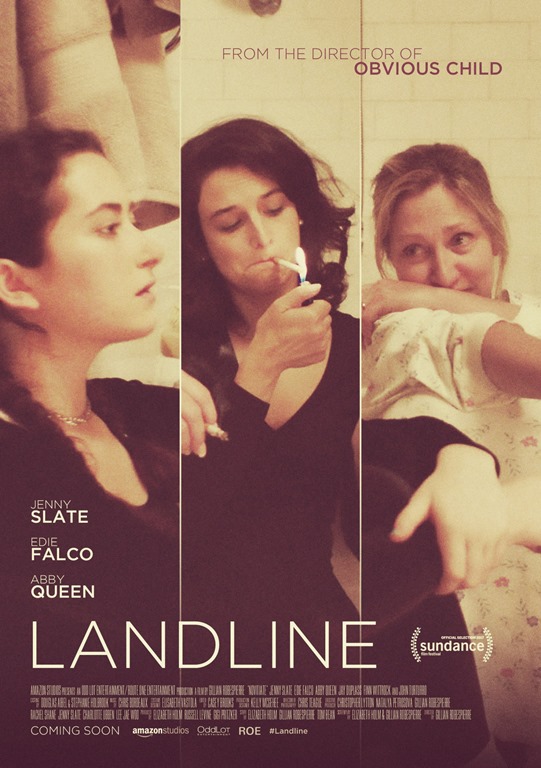
This week, I attended a sneak preview at The Film Society Of Lincoln Center for the new comedy, “Landline”, starring Jenny Slate, Edie Falco and John Turturro.

Synopsis

When sisters discover that their father has been unfaithful, what impact will this have on the life of their family?

Story

In the mid-1990’s, life is good for Dana (Slate) and her family.  She’s engaged to Ben (Jay Duplass), a sweet but dull young man who’s very much in love with her.  Ali (Abby Quinn), her teenage sister, has an impending high school graduation; while her parents are pushing her to attend college as they did, she is not quite so sure.  As for their parents Alan and Pat (John Turturro and Edie Falco), both siblings appear to get along splendidly with them, even if their own relationship with each other can cleave toward being a bit fractious, so put it mildly.  Alan and Pat, on the other hand, seem to have grown a bit distant over their years together.

At a party, Dana runs into Nate (Finn Wittrock), an old college flame with whom she winds up re-igniting their passionate relationship behind Ben’s back.  Meanwhile, Ali stumbles upon evidence that Alan is having an affair of his own.  Does Pat know about this?  If not, should Ali be the one to blow the whistle on her father?  On this matter, Ali is a bit conflicted; while she sees Alan’s unfaithfulness as wrong, she has also witnessed her mother’s behavior toward him as deliberately driving him away.  Unsure how to properly handle this awkward situation, Ali spills the beans to Dana and seeks her advice on the matter.

Before either of the sisters have the opportunity to confront Alan or Pat regarding this troubling news, Pat reveals to Alan that she in fact knows what he’s been up to.  The two separate and plan to divorce.  In the meantime, Ben is growing increasingly concerned about Dana; she moved in with her parents shortly after things started heating up with Nate and Ben has barely heard from his fiancée in the intervening period.  Ultimately, Dana confesses to Ben that she’s been seeing Nate, which causes Ben to break up with her.  Realizing that she needs to settle down with Ben, can Dana convince him that she’ll be faithful in the future?  Also, with their family on the verge of breaking apart, can the two sisters put their differences aside (at least temporarily) to try to unite their family?

Review

It’s hard to tell if the gifts of Gillian Robespierre as a filmmaker inspires the performance delivered by actress Jenny Slate or if it’s Slate’s acting that inspires Robespierre’s directing choices.  Perhaps it’s a little bit of both.  Regardless, they make an incredible collaborative team, proving that their previous work together, “Obvious Child”, was no fluke; “Landline” shows that the team of Robespierre and Slate do not suffer from the dreaded Sophomore Jinx.  Once again, they are able to present a story full of both mirth and sorrow, often simultaneously.

A great deal of credit also must go to Elisabeth Holm, who shares the screenwriting credit with Robespierre.  This duo also co-wrote “Obvious Child”, their breakout movie from several years ago.  They have a sensibility and storytelling style that appears to bring out the very best in each other; remarkably, the pair are able to find humor in truth and truth in humor.  The characters they have delineated are rich and, as heartbreakingly real as they may be in their flaws, are also deeply funny, even when they don’t realize their own ridiculous behavior. 

Following the screening, there was a question and answer session with Robespierre, Slate, screenwriter Holm and Slate’s co-star Abby Quinn.  Robespierre said that the story came about because she and Holm share a similar background; not only did they grow up in New York City during the 1990’s, they also both saw their parents divorce during that same period.  In their case, this shared trauma only served to strengthen the familial bond that both had with their respective parents and siblings.  Slate said that following “Obvious Child”, she and Robespierre kept in touch and were eager to work together again.  

Landline (2017) on IMDb

Tuesday, July 18, 2017

“Valerian”– Movie Review

val

This week, I attended a New York Times Film Club screening of the new science-fiction/adventure “Valerian And The City Of A Thousand Planets”.

Synopsis

In the future, a planet with peace-loving people is destroyed – but can the agents charged with investigating the attack find out who did it and why?

Story

The society that exists on Alpha 400 years from now is a collective of humans and aliens who both live and work together in collaboration in order to improve each other’s life.  This is especially true in the demographically diverse City Of A Thousand Planets, which contains the largest population in all of Alpha.  However, the long-standing peace in the universe is disrupted when a planet is unexpectedly attacked and destroyed; only a small group of its inhabitants survive by escaping in a pod.  Slowly, over a course of many years, they try to rebuild their society – and all the while, plotting revenge.

With the universe’s peace disrupted, The United Human Federation is called into action.  The Federation is an organization of humans responsible for maintaining order and vanquishing possible threats to all of society.  Two of The Federation’s top agents are Valerian (Dane DeHaan) and Laureline (Cara Delevingne), who work as partners on all their missions.  They are assigned the task of investigating who attacked the planet and why.  In the meantime, The Federation Commander (Clive Owen) is kidnapped by the alien survivors of the destroyed planet so Valerian and Laureline are sent to rescue him. 

Upon finding The Commander, Valerian and Laureline are unable to free him without themselves confronting the aliens first.  Instead of being engaged in a fierce battle, the aliens relate their story to the agents; the new information they get from the aliens is alarming and forces the agents to view their situation in a whole new light.  With better insight into the aliens’ background and the motivations for their actions, the agents realize the objective of their mission must be altered.  Are the aliens justified in their capture of The Commander?  Did The Commander have prior knowledge about the attack and destruction of these aliens’ planet?  Can the agents help the aliens to restore their society?

Review

One might forgive a viewer who anticipates fun while watching the opening credits of “Valerian” – it’s quite a visual spectacle with musical accompaniment.  Unfortunately – between the special effects and the relentless action scenes – the movie as a whole winds up feeling like more of an assault on the senses rather than a coherent story featuring protagonists about whom we can invest our emotions or time.  Ultimately, at two and a quarter hours, the film is something of a slog rather than the fast-paced adventure to which it aspires.

By the end of “Valerian”, the viewer is left caring neither about the fate of the survivors of the destroyed planet nor about the future of the possible romance between Valerian and Laureline.  It is, in fact, the aliens who seem considerably more human than the actual humans themselves – and considering it’s the humans who are the protagonists, that’s not something that bodes well for the movie itself.  Also, these members of The United Human Federation of the future appear to sustain the racism and sexism of the present:  very few non-white faces are seen among them and there seem to be no women in positions of authority. 

What little there is of entertainment value in “Valerian” comes from being able to quickly identify the famous faces, many of whom appear only in cameos.  In addition to Clive Owen, they include Rutger Hauer, Ethan Hawke and (as has been widely publicized already) Rihanna as a character called Bubble – a shape-shifting alien who performs a seductive dance for Valerian.  Although their characters do indeed move the story forward, their presence it not enough to elevate this film.  We can hope that there will be no sequel to this motion picture – or if there is, it’ll be at least a half hour shorter. 

Valerian and the City of a Thousand Planets (2017) on IMDb

Thursday, June 29, 2017

“The B-Side”– Movie Review

Bside

This week, I attended a New York Times Film Club screening of the new documentary “The B-Side”.

Synopsis

Retired portrait photographer Elsa Dorfman reflects on her long career

Story

For decades, Elsa Dorfman made a career as a photographer specializing in portraits.  Before her retirement, Dorfman was considered a pioneer because she was one of the few female professional photographers.  What further set her apart from others was the fact that she was using a relatively new camera at the time:  The Polaroid Land Camera, which was considered revolutionary at the time because it generated instant photographs without having to be processed through the traditional development process.  While the cameras were sold in the retail market and turned out to be a big hit with consumers, the company also manufactured specialty cameras as well.

One such specialty camera was a model which was capable of producing 20” x 24” photographs.  Dorfman was able to get one of these cameras despite the fact that they were in limited supply; using this for her portrait photography caused her career to take off.  Since there were few people at the time who could market portrait photographs to the general public of this size, she was considered one-of-a-kind.  As this set her apart from most other photographers, she was in high demand for her portraits -- by both the public and celebrities alike.   

Years later, Polaroid started making cameras that could produce even larger photographs; these were 80” x 40” in size and came out of an enormous printer.  These cameras were intended for use by professionals who were seeking “life-size” pictures as well as photos that could be mounted on a wall in a gallery.  Dorfman used this device to take shots of celebrities, especially her close friend, the controversial poet Allen Ginsberg.  But eventually, technological advances became such that film was no longer used in cameras and Polaroid found itself out of business.  It was not long thereafter that Dorfman decided it was time for her to retire.     

Review

There is no doubt that “The B-Side” contains a certain sweetness to both the documentary and its subject.  However, that alone does not necessarily make a good documentary.  One of the most common problems in documentaries is what’s known as The Talking Heads Syndrome; this is where the documentary consists solely (or primarily) of interviews with people about the subject of the documentary.  In the case of “The B-Side”, it’s much worse than that – there is only one talking head, that of Dorfman herself.  The fact that this filmmaker, a veteran documentarian, fell into what would be considered “rookie mistakes” is a bit startling. 

Another problem is with the subject herself.  Unless you are a photography buff, you may not be familiar with Dorfman’s work.  What we are given to understand from this documentary is that her photographs are not remarkable so much because of her subjects themselves but more because of the technology she used, which was cutting edge at the time.  This is interesting only up to a certain point (getting former Polaroid employees to expound on the cameras themselves might have been useful to include in the documentary).  Dorfman herself admits that while she did photograph famous people (Bob Dylan and Ginsberg), she was never looking to capture the inner person, just their external shell. 

Curiously, when Dorfman shows off her photography, she often holds up the pictures in a way that completely obscures her face while she talks about the photo; it is almost as if to say, “My work is more important than I am”.  While making the subject appear humble and serve to further ingratiate her to the viewing audience, it isn’t necessarily good filmmaking; this could have been shot in a more elegant (professional) manner.  Why the director made this choice is unclear.  What is perhaps a saving grace of “The B-Side” is its length; its running time is barely over an hour. 

The B-Side: Elsa Dorfman's Portrait Photography (2016) on IMDb

Thursday, June 08, 2017

“The Hero”– Movie Review


Hero

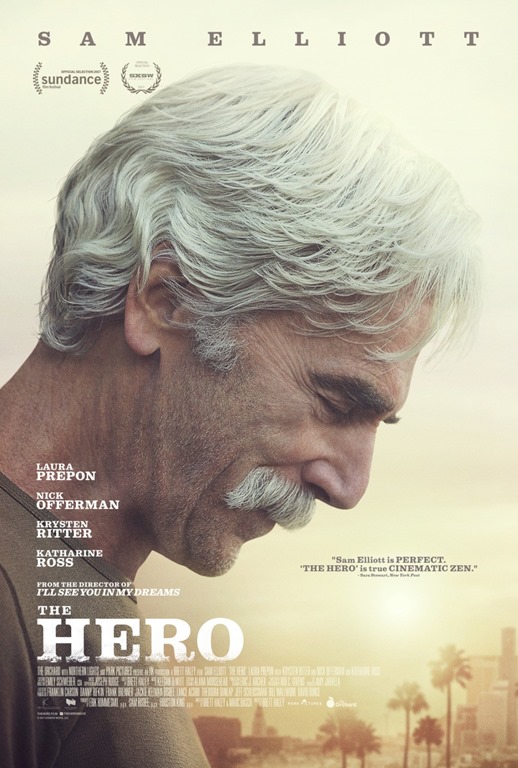
This week, I attended a New York Times Film Club screening of the new drama, “The Hero” starring Sam Elliott.

Synopsis

When an actor learns he is dying, will he be able to resolve family conflicts before it’s too late?

Story

Hollywood is known to be a cruel town – and especially cruel to those unable to resist aging.  This is precisely the problem Lee (Elliott) is facing now; as a senior citizen, the roles he used to get acting in Westerns on television and in movies have dried up considerably.  But things are about to get much worse for Lee; upon meeting with his doctor, he learns some rather unfortunate news about his biopsy – at the age of 71, he’s been diagnosed with pancreatic cancer and the prognosis is none too promising.  Lee is now forced to confront his new reality and limited future. 

Lee has initial difficulty internalizing his diagnosis; this manifests itself in his inability to tell his neighbor Jeremy (Nick Offerman), his ex-wife Valarie (Katherine Ross) and their daughter Lucy (Krysten Ritter), from whom he has been long estranged.  One day while visiting Jeremy to purchase weed, he meets Charlotte (Laura Prepon), another of Jeremy’s “customers”; they hit it off immediately and shortly thereafter start dating.  Insecure about why such a young woman would be interested in him, Lee attends Charlotte’s stand-up act at a comedy club; immediately feeling humiliated when she makes jokes about the hazards of dating an older man, he exits, convinced they are over.

Charlotte apologizes and tries to make amends; reunited, it is at this point that Lee finally is able to summon up the courage to reveal his diagnosis.  This being a much-needed breakthrough, Lee now decides to meet with Valarie and Lucy separately in order to break the news to them.  Although Valarie responds sympathetically, Lucy is more of a challenge; having been disappointed by her father countless times over the years, she sees this as yet another side of his absentee fatherhood.  With time running out, will Lee be forced to spend his remaining days alone or can those closest to him provide the necessary support until the end?

Review

As much of a pleasure Sam Elliott is to watch (and hear) in “The Hero”, it is not necessarily enough to recommend seeing the movie – unless, of course you’re such a hardcore fan of Elliott that skipping one of his works would be unthinkable.  As his girlfriend, Prepon’s Charlotte seems unworthy of Lee (who apparently was no angel himself in his earlier years); after insulting him in her stand-up comedy act while he’s in the audience, she unconvincingly tries to explain her reasoning for doing so.  It seemed the perfect opportunity for Lee to invoke the maxim, “Many a truth is often said in jest”. 

Haley’s screenplay is somewhat hackneyed; we’ve pretty much seen this story before and in considerably better movies.  As a storyteller, he really doesn’t seem to be able to explain things terribly well (e.g., a big deal is made of Lee losing his cell phone and then in the very next scene, it is apparently recovered – but how and when, we have no idea).  For another thing, Haley seems to overuse shots of Lee standing on the beach staring at the ocean.  It puts in the viewer’s mind the thought that one of those “A Star Is Born” types of moments might be coming. 

Following the screening, there was a question and answer session with both writer/director Brett Haley and Elliott.  Haley said that he came up with the idea for “The Hero” after working with Elliott on a previous project ("I'll See You in My Dreams") and they wound up shooting this movie in only 18 days.  Elliott said that one of his reasons for doing the film was because he felt that the character exemplified a problem he himself ran into as an actor:  the fact that he gets known for a certain type of role and winds up being “boxed in”.  Despite wanting to star in Westerns since childhood, after a while, he felt a desire to do something different but found it difficult to get cast in any other type. 

The Hero (2017) on IMDb

Thursday, June 01, 2017

“Churchill”– Movie Review


cox

This week, I attended a New York Times Film Club screening of the new biographical drama, “Churchill”, starring Brian Cox and Miranda Richardson. 

Synopsis

When British Prime Minister Winston Churchill grows increasingly depressed over the impending Battle of Normandy on D-Day, can his wife set him in the right frame of mind to successfully lead the country?

Story

At the beginning of June 1944, the world was in the thick of its second war and it was just days before Operation Overlord would commence.  It was at this time that British Prime Minister Winston Churchill (Cox) met with the generals from The Allied Forces – Eisenhower and Montgomery (John Slattery and Julian Wadham) – to review the final version of their plan for The Battle Of Normandy.  To their surprise, Churchill informs them he thinks the plan will not work; while ambitious, it is far too risky and The Allies will incur many casualties.

In a private meeting, Ike tells Churchill that regardless of what he thinks, they are going forward with the plan – it’s just a matter of when, depending on favorable weather conditions.  Churchill warns him there was a similar plan in The Battle of Gallipoli during The Great War and it failed miserably; Ike tries to reassure him that there have been great advances in the past 30 years, but Churchill remains unconvinced.  Realizing the generals will go against his wishes, Churchill then counters by saying he will be accompanying the troops to Normandy; but after Ike has a conversation with the King of England, he tells Churchill he cannot go.

As all of this unfolds, Churchill’s drinking increases and his mental state declines.  Becoming increasingly depressed, he begins to exhibit erratic behavior and poor temperament around colleagues and his wife Clementine (Richardson).  Finally, Clementine has enough; she feels that her husband has been marginalizing her and it’s time that she leave him.  But after Churchill’s colleagues try to persuade Clementine into staying for the benefit of the country, will she be able to drag her husband out of the deep depression in which he’s mired?

Review

It may be better left to history buffs – either those of World War II or, more specifically, experts on Churchill himself – to fact check much of what it set forth in “Churchill”.  Regardless, it must be noted that flaws in the movie are of the cringe-worthy variety – whether we’re talking about heavy-handed imagery or dialog (particularly of note is the scene where Churchill is supposedly praying, but his supplication evolves into oration to The Almighty).  There are plenty of aspects about this that challenge your disbelief, including the fact that a secretary turned Churchill around on his views and that he only voiced disagreement about the Operation Overlord plans days before their execution when in fact they had been in the works for months. 

As a historical work, “Churchill” could hardly be considered a hagiography; quite the opposite, in fact – The British Bulldog comes across not only as quite fallible but also leaves the audience wondering if he should have been fit for a straitjacket.  That becomes problematic because it results in the audience having a protagonist for whom it is difficult to root.  Add to that the fact that since this is obviously a slice of history, we all know how it turns out so there is very little left in the movie that creates any requisite suspense for viewers. 

While the film may have been something of a disappointment, what saved the evening was a post-screening question and answer session with its star, Brian Cox.  Cox said that he had to gain around 30 pounds in order to play Churchill and he is still battling to lose that weight.  He maintains that while there are many factual elements to the movie (it was written by a historian), there are elements that were manufactured – the secretary portrayed in “Churchill” is actually an amalgam of multiple Churchill secretaries.  Also, Cox noted that while his character was seen smoking many cigars, he doesn’t smoke them himself; during the shoot, they utilized what were basically electronically-operated cigars – basically, he was vaping. 

Churchill (2017) on IMDb

Friday, May 19, 2017

“Dean”– Movie Review

Dean_2017

This week, I attended a New York Times Film Club screening of the new comedy-drama, “Dean”, starring Demetri Martin, Kevin Kline and Mary Steenburgen. 

Story

Dean (Martin) and his father Robert (Kline) are having difficulty dealing with the loss of their family member – Dean’s mother and Robert’s wife.  Suddenly, both men find their respective world turned upside down and without direction.  Robert decides he’ll sell the family’s New York house; it’s too big to live in by himself and besides, there are too many memories.  Dean, on the other hand, demurs; that house has memories he desperately wants to retain and neither wants nor needs more disruptions.  While Robert wants to meet with his son in order to discuss plans on how to proceed, Dean avoids it by taking this opportunity to make a business trip to Los Angeles.  

While in LA, Dean meets with an advertising agency that wants to hire him to make humorous illustrations for their client’s upcoming ad campaign.  Once he realizes the gig is not for him, Dean decides to return to NYC to finish his next book of cartoons.  But before he goes, Dean’s invited to a party where he runs into Nicky (Gillian Jacobs), a gorgeous blonde who seems to be aggressively flirting with him.  In no hurry to return to New York, Dean extends his Los Angeles trip to spend time with Nicky.  Meanwhile, Robert has hired Carol (Mary Steenburgen), a real estate agent to help sell his house.  The two find themselves working closely and eventually a mutual attraction develops.   

Ultimately, Dean and Nicky get to spend time alone right before he has to return to New York; although they both felt a strong connection to each other, their future together remains uncertain.  In the meantime, Robert and Carol continue to enjoy each other’s company.  But are both ready to go to the next level in their relationship?  Upon Dean’s return, Robert sells the house and moves into a smaller apartment.  However, there are still unresolved issues between father and son.  Can the two put their differences aside to support each other in their grieving process or will they forever remain estranged?

Review

While it may sound somewhat oxymoronic to describe the surprisingly pleasant “Dean” as a comedy about death, loss and grieving, that is precisely what it is.  Deal with it.  In fact, if that doesn’t sound sufficiently confusing, the movie is actually a romantic comedy.  Before you say, “You can’t do that!”, remember that people also said about “Hogan’s Heroes” that you can’t make a situation comedy about a Nazi prisoner of war camp.  Sometimes, “experts” are just plain wrong.  Let’s just stop right there lest a diatribe on the 2016 presidential election proceeds. 

The reason why “Dean” works as well as it does is precisely because the jokes are genuinely funny.  Judging from this movie alone, it would seem like writer-director-star Demetri Martin is a hybrid of Woody Allen and Noah Baumbach as far as his filmmaking style is concerned.  While some may argue that it is unfair to Martin to make such a comparison, it is meant as a compliment – but this young man certainly has a very long way to go in order to be favorably compared to these men in his entire body of work.  We will just have to see what the future holds for Martin. 

One of the more amazing things about “Dean” is that not only did Martin write-direct-co-produce and star in this movie, he also took a credit for creating the illustrations as well – and arguably, these inventive and clever cartoons are worth seeing the film all by themselves.  While Martin doesn’t exactly seem to break any new ground as a director, his screenplay is truly just as funny and unique as the drawings themselves (that said, however, there are some moments that don’t ring true.  For example, are we really to believe that Dean’s father, a professional engineer, can’t figure out how to use a cell phone?).  Also, although it could be said that acting isn’t necessarily Martin’s greatest strength, the performances by Kline and Steenburgen are delightful. 

Dean (2016) on IMDb

Tuesday, May 09, 2017

“Paris Can Wait”– Movie Review

PCW2

This week, I attended a New York Times Film Club screening of the new romantic comedy, “Paris Can Wait”, starring Diane Lane and Alec Baldwin.

Synopsis

When a married woman accepts an offer from a charismatic Frenchman to drive her to Paris, will she succumb to his charms or will she remain faithful to her husband?

Story

While in Cannes joining her husband Michael (Baldwin) on a business trip, Anne (Lane) is suffering ear problems.  Michael is too preoccupied with the exigencies of his film production business, so he doesn’t have the opportunity to spend time with Anne, much less come to her aid regarding her ear problem.  Anne, meanwhile, has also been yearning for a vacation – something which Michael has been way too busy for in recent years.  When problems on a current production require Michael to head to Budapest before proceeding to Paris, Anne agrees to tag along – but when her ear condition precludes her from flying, she instead decides to head straight to Paris on her own.

Originally planning to take a train from Cannes, Anne changes her mind when Jacques (Arnaud Viard), Michael’s business partner, offers to drive her to Paris himself.  Not long into her trip, Anne believes she’s made an egregious mistake.  First, Jacques’ car is old, making it questionable as to whether or not it will survive the journey.  Also, it turns out Jacques isn’t exactly the world’s best driver.  Lastly – and most important – Jacques is not taking a direct route to Paris.  While Anne may be in a hurry to get there, he is obviously not.  Jacques takes her on quite a few side excursions along the way.

Jacques turns out to be quite the connoisseur on a great many things.  These detours open up Anne to a whole new world she would not have otherwise experienced:  great architecture, fabulous scenery and most of all, delicious food and wine.  But along the way, it becomes clear that Jacques may have some ulterior motives on this seemingly generous offer to drive Anne to Paris.  A lonely man who never married, it appears as though he may be trying to seduce Anne and possibly even steal her away from Michael.  Upon finally reaching Paris, Jacques makes Anne an offer to rendezvous with him.  Will Anne leave her husband of 20 years to have an affair with this man?

Review

“Paris Can Wait” is certainly a pleasant enough little trifle, but if you are going to extend the food metaphor (albeit painfully), it is more of a light croissant rather than the heartier cassoulet; it is enjoyable in the moment, but quickly forgettable.  Lane seems to be trying to reprise her success in “Under The Tuscan Sun” with a Gallic twist, combining it with a bit of “Eat, Pray, Love” (with considerable emphasis on the eat).  The main reason to see “Paris Can Wait” – should you choose do to so – is for the breathtaking French sites (especially the countryside) and the mouthwatering shots of the sundry foods.

The biggest problem with “Paris Can Wait” is its flimsy script.  Its dialog can be a bit predictable, including and especially when it comes to the rather awkward and clumsy attempts to impart bits of exposition with the audience.  Additionally, the story lacks any real conflict; although the two face minor setbacks along the way, there is no true antagonist that must be overcome by the two leads either individually or collectively.  Therein lies a serious issue the movie cannot overcome; one never gets the sense of impending doom for either Lane’s character or her marriage. 

But of course the story behind the movie is what’s attracting the most attention.  “Paris Can Wait” was written and directed by Eleanor Coppola, the wife of Francis Ford Coppola; at the age of 81, she’s making her debut as both a screenwriter and feature film director.  Despite her familial connections, it’s nevertheless rather impressive that anyone of such an age would take on such a challenge.  At this point, it almost seems facetious to talk about her “career” as a filmmaker, but in the event she does attempt another motion picture, hopefully it would be something more compelling than a fantasy vacation.  

Paris Can Wait (2016) on IMDb

Sunday, April 30, 2017

“Aardvark”– Movie Review

Aardvark__AAD4044.tif Aardvark__AAD4044.tif

On the final weekend of The Tribeca Film Festival, I attended a screening of “Aardvark”, a drama which made its World Premiere earlier in the festival; it stars Zachary Quinto, Jenny Slate and Jon Hamm. 

Synopsis

When an emotionally disturbed man seeks assistance from a therapist, can she help mend the relationship with his brother despite her romantic involvement with the brother?

Story

Josh (Quinto) finds himself at something of a crossroads in his life.  That’s why he’s seeking assistance from Emily (Slate), a local Clinical Social Worker who’s set up practice out of her own home in this Queens, New York, neighborhood.  A troubled man, Josh is on multiple medications due to a prior diagnosis of schizophrenia.  In addition to that, he’s currently experiencing great anxiety over his relationship with his older brother Craig (Hamm), whom he hasn’t seen in years.  Through their sessions, Emily sets out to peel back the layers to understand the source of the conflict.  

Craig, by contrast, has gone on to enjoy a life of great success as an actor in Hollywood.  Having starred in a hit television series, Craig’s returned to his Queens neighborhood to sell the house that was left to him by his and Josh’s late parents.  Despite being in the vicinity, Craig is reluctant to visit Josh; Josh, however, believes he is being visited by Craig, but these are hallucinations that are merely a manifestation of his mental illness.  Sadly, when Josh sees a police officer or a homeless woman, he believes that this is his brilliant brother Craig as an actor in character. 

When Craig visits Emily to check up on Josh’s condition, they hit it off immediately and start dating.  Before long, they enter into a romantic relationship which both know to be wrong but irresistible.  Over time, Josh’s condition worsens and Craig becomes increasingly distant.  After suffering a beating from some locals, Josh is hospitalized; Emily visits him and is confronted with the realization it is imperative Craig gets over his hesitancy to see Josh – but when she finally convinces Craig to visit him once Josh is discharged, will their meeting patch things up or only prove to make matters worse?   

Review

Based on the little amount of screen time the character gets, this is clearly not Craig’s story.  Therefore, simply by the process of elimination, it would seem that either Emily or Josh have the majority of time in “Aardvark”.  So which one of them is the protagonist here?  It can’t be Emily because she’s part of the problem – she is, arguably, the world’s worst therapist based on the many bad decisions we see her make throughout the story (including bad decisions she’s made in her past, given what eventually gets revealed about her). 

This leaves Josh as the only character who could possibly be perceived as the protagonist of “Aardvark”.  Therein lies the movie’s fatal flaw.  Josh, as sympathetic as he may be, is a difficult character to root for because his illness precludes him from being in control of his own life; as the protagonist, Josh should be the one with the character arc, but it is in fact his brother, Craig, who goes through the transformation.  This change is not voluntary; it is in fact forced upon him by Emily, which results in making Craig appear less heroic in the eyes of the audience because he did not embark on this change himself.  Ultimately, “Aardvark” is a film in search of a protagonist it never quite finds.     

Following the screening was a question and answer session with writer/director Brian Shoaf.  Shoaf knows Quinto from their days studying acting in college; over the years, they attempted to work together, but it never worked out.  Eventually, Quinto formed a production company with a mutual friend of theirs and wound up making several films.  Later, Shoaf sent Quinto the screenplay for “Aardvark” through his agent and Quinto decided he wanted to play Josh so much he agreed to co-produce.  Through Quinto, they were able to add Hamm and Slate to the cast, which made funding easier. 

Aardvark (2017) on IMDb