Sunday, July 24, 2011

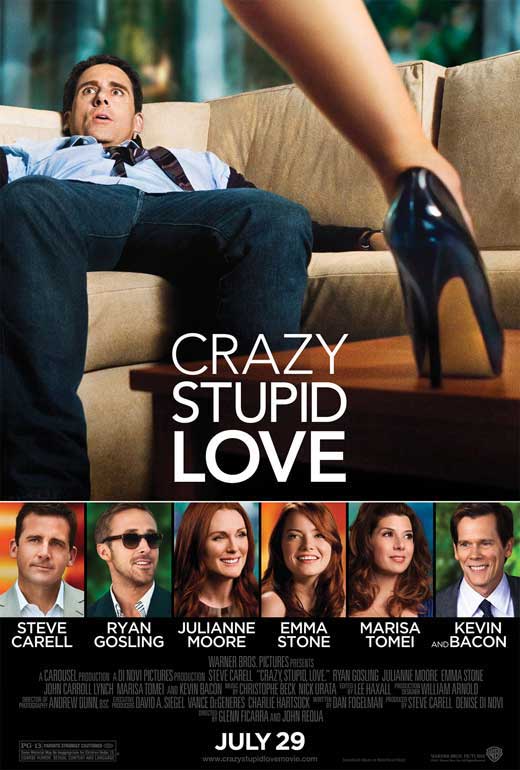
“Crazy, Stupid, Love” – Movie Review


This weekend, my movie class had a bonus screening of the romantic comedy “Crazy, Stupid, Love”, starring Steve Carell, Ryan Gosling, Julianne Moore, Emma Stone, Marisa Tomei and Kevin Bacon.


Synopsis

After a long-time married man learns his wife wants a divorce, he meets someone who decides to turn him into a womanizer – but when his wife later informs him that she wants him back, will they reunite? 


Story

Married for nearly 25 years, the last thing Cal (Carell) expects is to be told by his wife Emily (Moore) that she’s had an affair with a co-worker (Bacon) and now wants a divorce.  Stunned, Cal immediately moves out and tries to get back on track.  Hanging out at singles bars, he’s so out of practice that he strikes out at every opportunity – until he’s spotted by Jacob (Gosling), a young stud who decides to take Cal under his wing and make Cal his pet project.  Teaming up, Jacob gives Cal a makeover and mentors him on how to talk to and pick up women in a bar with similar aplomb. 

Eventually, Cal hits pay dirt with Kate (Tomei), a schoolteacher he meets at the bar.  This success breeds confidence in Cal and he proceeds to pick-up women at an impressive clip.  Around this time, however, Emily is starting to question her desire for the divorce – not so much because she doesn’t appreciate the attention from the co-worker with whom she’s having the affair, but because she genuinely misses her husband … not to mention the fact that friends and family seem to be turning against her somewhat.  Add to this the fact that Cal & Emily’s adolescent son has a crush on the babysitter who is also experiencing unrequited love for Cal and things are rapidly getting very messy. 

Ultimately, Emily begins to see that the romantic entanglement with her co-worker is becoming increasingly cumbersome both at the office and at home.  However, just when Cal finds out that Emily is considering a reconciliation, it all gets called off when she discovers that he’s turned into something of a lothario.  But can Cal somehow win back his wife by convincing Emily that he’s more interested in being her husband than a swinging single?


Review

While a comedy, “Crazy, Stupid, Love” is not really something you would characterize as raucous, ribald or laugh-packed; much of the story has dramatic overtones to it and a good deal of the humor is gentle, understated and spread out.  More mildly amusing than a laugh riot, the funniest scenes come about as a result of some surprising plot twists – one in a big reveal in an uncomfortably awkward scene when Emily and Cal run into one of his spurned, angry conquests and another that concludes the second act in a somewhat farcical tone as all of the different characters and their various subplots converge at a most inopportune moment. 

I would recommend this movie, but with the caveat that you manage your expectations when seeing this romantic comedy – it’s definitely not wall-to-wall gags, but it does have a few genuinely funny moments as described above with more low-key jokes interspersed throughout.  One good thing that the movie has going for it is the fact that the screenwriter managed to combine a number of interesting characters with subplots that are compelling enough to maintain your curiosity about their resolution just as much as you would have for the main story of Cal and Emily.  Some really clever twists and turns occur in crucial plot points as well that will be sure to keep the audience on their toes at all times. 

The majority of the class liked this movie quite a good deal and understandably so, I believe.  Our instructor predicts that this will be a big hit and I would have to agree with him on this one.  I’m a big Marisa Tomei fan and she’s quite funny in the few scenes she has in this movie, but I nevertheless think she was unfortunately and unnecessarily under-utilized here.  If you want some fun, escapist entertainment and have had your fill of Transformers, Harry Potter and Captain America, then this might just be the perfect mid-summer movie for you. 



Friday, July 22, 2011

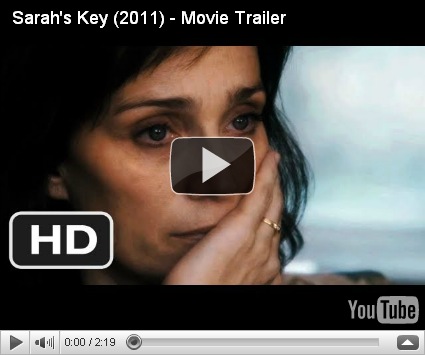
“Sarah’s Key” – Movie Review


This week in my movie class, we saw the French drama “Sarah’s Key”, starring Kristin Scott Thomas and (in a small role) Aidan Quinn.


Synopsis

An American journalist living in Paris is assigned to write a World War II story for a magazine article – but when her research causes her to investigate the life of a girl from that period, will learning the truth about her risk losing her own family?

Story

Julia (Thomas) and her family have moved to France so she can work on pieces for the Paris bureau of the news magazine that employs her.  Being assigned an article on the French Holocaust known as The Vel' d'Hiv Roundup where the French government had their police arrest Jews living in their country so they could be turned over to the Nazis who occupied their land in mid-July of 1942, her research uncovers the amazing story of a girl named Sarah, who was only 10 years old at the time.  Trying to save her little brother Michel from the Nazis, Sarah locks him in a secret closet in their apartment and makes him promise not to leave until the family’s return in a few days. 

While learning Sarah’s secrets, Julia also winds up learning secrets of her in-laws as well.  It seems that by coincidence, the Paris apartment Julia and her family are about to occupy was the same apartment in which little Sarah lived with her own family during the war; the family of Julia’s in-laws moved into the apartment just weeks after Sarah’s family had been arrested and they have handed down the flat to their son and his wife.  Simultaneously, Julia discovers that she is now pregnant – something of a miracle since doctors told her she would never be able to have more children after giving birth to her daughter, who is now an adolescent.

As Julia uncovers layer upon layer of Sarah’s story, her in-laws’ own mystery begins to unravel, with family members soon learning the horror of the long-kept secret.  Combining this ugly past with the fact that he is faced with a future of suddenly having to care for a quite unexpected baby, Julia’s husband grows angry and distant; not helping matters any is the fact that Julia no longer wishes to live in the family’s apartment upon knowing its history.  On top of that, she is now gallivanting all over the globe in pursuit of a resolution to Sarah’s saga.  But will Julia ever find the truth about Sarah’s ending – and will her family remain intact upon its revelation?

Review

Just in case you need another reminder for why you need to hate the French, along comes “Sarah’s Key” – somewhat ironic, since it’s a French production.  When it was announced in class that this was the movie we would be seeing, a number of people audibly gasped and sighed – all of them women who likely read the novel on which it was based.  While you might be especially taken with this film if you are Jewish or a woman (or both), I have to say that I found it a little on the melodramatic side for my tastes and therefore can’t really feel totally comfortable giving it a recommendation. 

Part of the problem with the movie comes with its heavy-handed treatment of the story and its dialog, not to mention the “magical thinking” nature of things:  Julia’s pregnancy, characterized as a “miracle” (perhaps an immaculate conception, given the apparent aloofness between husband and wife), the coincidence of the apartment and the impossible finding of Sarah’s now middle-aged son (Aidan Quinn).  Especially painful to watch – and listen to, due to the dialog – are the last scenes of the movie, when the actors are given the opportunity for some scenery chewing and the character’s closing remarks falling on your ears as if it were something like a benediction when it seems as though it was intended to be deeply philosophical. 

Prior to the screening, our instructor interviewed Phil Rosenthal, writer/director/star of the hilarious documentary “Exporting Raymond” (see my review here).  Rosenthal was there to promote the fact that the DVD of his documentary is soon to be released.  Just in case you never got around to catching this movie in the theaters in its understandably limited release, I strongly encourage you to rent the DVD.  Rosenthal is one of the most naturally funny raconteurs I have ever had the pleasure of hearing; he has the unique ability to find humor in just about any situation. 


Friday, July 15, 2011

“The Tree” – Movie Review


This week in my movie class, we saw an Australian drama called, “The Tree”, based on a novel titled, “Our Father, Who Art In A Tree”. 

Synopsis

When a young woman suddenly finds herself a widow, she is forced to support and raise her children as a single parent – but when her daughter believes her late father’s spirit lives on in an old tree, the woman also develops a similar emotional attachment. 

Story

In her late 30’s, the last thought Dawn O’Neil has on her mind is becoming a widow – but there she is one day when her husband unexpectedly dies of a heart attack while driving their eight year old daughter Simone home one day.  All of a sudden, Dawn now finds herself forced to raise her four children by herself, all the while still mourning her loss.  Depressed and inconsolable, Dawn sleeps in and is hard to roust from bed, leaving the daily chores to her eldest, a teenage son, who soon seeks a part-time job to pitch-in while remaining in high school.  

After a couple of months, Simone believes she’s made a discovery in the imposing, ancient fig tree that’s grown long and hazardous roots in the family’s backyard – her father, she is certain, is actually alive in that tree.  While she can’t see him or hear him, Simone nevertheless believes that they are able to communicate with each other and continue their familial relationship.  Delighted with her discovery, Simone can’t help but share this with her mother, who, of course, is immediately skeptical, but decides to humor her daughter in any event.  Not long after this, however, Dawn finds herself believing Simone and proceeds to develop her own communication with the dangerous arbor. 

Eventually, Dawn is able to pull herself together enough to get a job as an assistant at a plumbing supply shop where she develops a relationship with George, the proprietor.  Once Dawn’s friendship with George blossoms into a romance, Simone immediately becomes angry because she feels as though her father has been forgotten.  However, when it becomes apparent that the backyard tree is endangering not only the entire family but their house as well, will Dawn be able to sacrifice her relationship both with it and Simone to have it removed for everyone’s safety? 

Review

Sure, it would be incredibly easy to characterize this movie as a “chick flick”.  But would doing so necessarily be a pejorative?  I suppose that depends on what the term “chick flick” might mean to you.  “The Tree” is about feelings and spiritual beliefs and – most ostensibly – about how a grown woman copes with single parenthood in a most unlikely setting.  So, is describing it as “a chick flick” trivializing the film?  Not necessarily, I would suggest, particularly, if that was the intended audience of the filmmakers, which is what appears to be the case – and that’s OK, even if it means it’s not my cup of tea. 

While it may not necessarily be the kind of movie that might cause some women to reach for the tissues every couple of minutes, you might find it a nice alternative while your man sees the latest “Transformers” movie.  Am I generalizing?  Yep, I sure am.  Am I guilty of Sexual Profiling?  Ya, you betcha.  Not apologizing for either one, by the way.  When movies are made, some of them are designed to appeal to the widest possible audience, while others are targeted to a specific demographic; this one fits into the latter category.  Did I love it?  No – I had issues with how quickly and easily Dawn abruptly changed from doubter to believer.  Also, I thought there were too many characters in the story, leaving some to be under-developed or undeveloped; additionally, some of the dialog is a bit clunky, as you might pick up from the trailer, below. 

Prior to the screening, our instructor re-interviewed director Chris Weitz, who was there to follow-up on the interview he gave us when we recently screened his latest movie, the wonderful “A Better Life” (please click here for the review, just in case it missed you).  Weitz went a little more in-depth about his background, describing his close relationship with his brother, four years his senior.  Having a similar sensibility in their youth, they went on to collaborate writing stage plays and screenplays in adulthood; Weitz said that his older brother had greater discipline for the craft of writing, which is why he went on to some success as a playwright. 

Monday, July 11, 2011

Scotch By Region


Recently, I had the opportunity to take a class at The Astor Center of New York City called “Scotch Whisky: A Regional Tasting Tour” where attendees were given the opportunity to sample Scotches from different parts of Scotland to get a better appreciation of how they differed from one part of the country to another. This gave me a chance to not only revisit a couple of my own personal favorites but also, to try ones I’d heard of but never tasted before, as well as to provide an occasion to learn about some that were unfamiliar to me.

The evening actually began not with a Scotch but instead with an old cocktail made with the spirit. Blood & Sand was a cocktail created in the era of silent movies as something of a tribute to the Rudolph Valentino film of the same name. In this flick, Valentino played the part of a bullfighter and it was believed that the combination of ingredients for this drink perfectly matched the spirit of the film. The recipe is as follows:

  • ¾ oz. Benriach 12 year old Scotch
  • ¾ oz. Luxardo Cherry Liqueur
  • ¾ oz. sweet vermouth
  • ¾ oz. orange juice

Shake up all of the ingredients in an ice-filled shaker, then strain into either a coupe glass (which is how we were served the cocktail in class) or a cocktail (i.e., martini) glass.

Benriach Scotch is a peated spirit from the Speyside region of Scotland; the instructor said he used that particular brand of Scotch because it is a relatively inexpensive yet flavorful type of Scotch that lacks any kind of oiliness. Additionally, you will notice that each one of the cocktail’s four ingredients are used in equal parts; the instructor pointed out that this is the mark of what he regarded as a finely crafted cocktail which doesn’t have any one ingredient completely dominating.

We started our tasting with one from the Lowlands region (Auchentoshan 12 year old), then moved north to the Highlands (Old Pulteney 12 year old) and Speyside (Glenrothes Select Reserve Single Malt, Glendronach 15 year Single Malt) before going to Campbeltown (Springbank 10 year old Single Malt) and finishing up with the islands – specifically, Islay (Laphroaig 10 year old and Port Charlotte PC7). In tasting each Scotch, we sample the dram first on its own, beginning with a thorough nosing to get a sense of its aroma, then tried it with a few drops of water added to see how this changed the chemical composition as well as to determine if it made the Scotch better or worse or merely different. This blog post will concern itself with only the first and last items from the tasting menu as these were two extremes.


The Lowlands region is in the southern portion of Scotland, near Ireland. Its Scotches are triple-distilled and contain no peat, which tends to make them good as an introductory Scotch. We tried an Auchentoshan 12 year old from the Lowlands, an 80 proof spirit aged in a combination of both bourbon and sherry casks. Adding the water to it released its sweetness; its lightness made for a good summertime Scotch.


Ending the evening was the Islay-based Port Charlotte (PC7). Aged only seven years, this had an even peatier and smokier nose and taste than even Laphroaig, which we had just tasted. This one also had the strongest alcohol content at 122 proof – as a result of that combination, there were quite a few people who started to cough and choke because they weren’t ready for such a powerful Scotch.

Have you ever tried any of the Scotches on this menu?  If so, please leave a comment and share your experience.

Thursday, July 07, 2011

“Project Nim” – Movie Review


This week in my movie class, we saw director James Marsh’s “Project Nim”, a documentary about a scientist’s experiments in the 1970’s to teach sign language to a chimpanzee – but when his personal issues insinuate themselves into the experiments, the study becomes invalidated.  Marsh is an Academy Award winning director for his documentary “Man On Wire”, about Philippe Petit, the guy who walked a tightrope between the twin towers of The World Trade Center. 

Story

Herb Terrace is a science professor at Columbia University in New York City. In the early 1970’s he got an idea that he believed would make him rich and famous: if he could teach a chimpanzee sign language, he could prove that they could communicate with humans, which would be a major scientific breakthrough in his field of study. Driven by his own blindingly egomaniacal ambition and arrogantly narcissistic lust for power and women, Terrace ruthlessly sets out to do whatever he felt was necessary to perform his experiments with the appearance of success and thus gain notoriety from the media as a result.

Starting with taking the newborn chimp from his mother at a primate research center in Oklahoma, he names the baby “Nim Chimpsky” after noted linguist Noam Chomsky. From there, the chimp is then whisked away to what will become a merry-go-round of research assistants who act as Nim’s caretakers or surrogate mothers – a number of whom wind up being seduced by Terrace at various points along the way. First, he engages a graduate psychology student who lives on the Upper West Side of Manhattan; there, Nim lives in her apartment where the woman attempts to raise him as a human child but he winds up destroying her home in more ways than one. Nim is then transferred to a young undergraduate student who finds increasing success in teaching Nim a vocabulary through sign language.

As Nim gets passed along from one person to another, he grows increasingly frustrated – and as a maturing chimp, he also grows increasingly strong, taking out his rage on others by physically assaulting them. Eventually, Terrace terminates the study and declares it a failure, despite all of the media hype suggesting the contrary. He returns Nim to the research center, but by then, the center is running low on money because they are encountering difficulty getting funding. The center then sells Nim to a medical research facility that conducts drug experimentation on animals, but he is rescued and is eventually purchased by the famous owner of an animal preserve in Texas, where Nim becomes despondent and lonely because he is the only chimp there.

Review

On the surface, this movie is about an experiment conducted by some bozo who tried to teach monkeys how to communicate with humans via the same sign language that deaf people use. What it’s really about, however, is so much more fascinating and infuriating, especially if you’re an animal lover. “Project Nim” is more about what happens when human folly unnecessarily ruins an animal’s life due to personal flaws such as selfishness and avarice; “Nim” is less about a scientific experiment gone awry than it is about how humans go awry in their life – and how their actions negatively impact on others, and in this case, a chimpanzee, too.

Although I found this documentary to be gripping and highly involving even if you’re not exactly a staunch supporter of PETA, I did have some misgivings about the way it was told, but not so much the story it was telling. For one thing, Marsh, the director, resorted to some obvious “faked” footage in order to tell his story; while the documentary is full of interviews, still photos and home movie footage, there were quite a number of scenes shot that were basically recreations or dramatizations of actual events that took place. Unfortunately, I feel this sometimes takes away from the credibility of the filmmaker and/or his film. Nevertheless, “Project Nim” is able to rise above this and remain a stunning example of the evil humans do both to each other and to animals.

Both before and after the screening, journalist Elizabeth Hess was interviewed; she was the author of the book, “Nim Chimpsky: The Chimp Who Would Be Human”, which inspired this documentary. She had some interesting observations about the movie, comparing it favorably to her book. Hess said that her original reason for wanting to write this book was that she was interested in doing a biography of an animal rather than a human being. As a consultant on the documentary, the author also mentioned that she’s seen the film a few times as she’s been involved in doing publicity; in the course of her travels, she has sat on panels that included Herb Terrace, whose presence is somewhat surprising since he has been made out to look like such a villain in the movie. Perhaps this reveals even more about his need for being the constant center of attention, even if it’s negative.


Monday, July 04, 2011

“A Better Life” – Movie Review


Recently in my movie class, we saw the drama “A Better Life”, directed by Chris Weitz (“About A Boy” and “American Pie”).  


Synopsis

When an illegal alien’s truck is stolen, he enlists the aid of his teenage son to try to recover it so he can resume his landscaping job – but will he be able to evade immigration agents who threaten to separate him from his boy?


Story

Carlos Galindo is a hard-working landscaper who awakes each morning at sunrise in his East Los Angeles home where he sleeps on the couch so his teenage son Luis can spend the night in an actual bed in the only bedroom in the house.   From there, he waits for Blasco, his boss, to arrive in his pick-up truck to take him to his scheduled appointment for the day’s work and together, they make the long drive to a wealthy West Los Angeles neighborhood.  Carlos would gladly love to have not only his own truck, but his own business, too, so he could be his own boss and make some real money to give Luis the upbringing he deserves -- but being an illegal alien who entered this country from Mexico nearly seven years ago, such opportunities are few and far between. 

One day, Blasco informs Carlos he’s returning to Mexico now that he’s made a substantial savings in the landscaping business thanks to the wealthy homeowners in West L.A.; Blasco’s plan is to purchase his own land somewhere in Mexico and live out the rest of his days as a farmer with his family.  Worried for his best employee’s well-being, he encourages Carlos to buy his truck so that he can assume the business and the clientele they’ve both worked to cultivate.  While Carlos would like nothing more than to do this, he’s forced to decline simply because he doesn’t have the $12,000 Blasco is asking.  Threatened with the possibility of completely losing his income, Carlos swallows his pride and asks his sister, a Los Angeles maid, for the money; knowing her brother’s work ethic and concerned for her nephew Luis, she gives Carlos the money she’s collected for her meager savings over the years so he can buy the truck. 

Now running the business and in need of a reliable co-worker, Carlos takes his truck to the nearby street corner where he knows Mexican day workers gather early each morning in the hope that they can earn some money; Carlos, being the ethical type, picks up Santiago, a man who earlier showed him a small kindness, hoping that this gesture will in some way repay the man.  Together, they go out on a landscaping job, but while engaged in the work, Carlos discovers that Santiago has just stolen his new truck, along with the gardening tools and his cell phone.  Joined by Luis, Carlos sets out in the dangerous East L.A. in an effort to try to reclaim his truck.  But even if he is able to recover the vehicle, can Carlos succeed in eluding the immigration agents who threaten to send him back to Mexico?


Review

Prior to the screening, our instructor lectured us about the post-World War II neo-realist films that came from Italy, including and especially Vittorio De Sica’s “The Bicycle Thief”, to which he favorably compared “A Better Life”. After seeing “A Better Life”, I now understand the reason for the comparison – and completely agree with the favorable likeness.  I was in no way prepared for how much I loved this movie.  In the beginning, I thought that the film was going to have the look and feel of one of those righteous-cause-of-the-week made-for-TV movies, but it wound up developing into so much more. 

This story is very compelling and fraught with suspenseful moments, performed by a number of actors with minimal – if any – acting experience.   Additionally, it manages to humanize the immigrant community and provides an insightful back-story as to how Carlos and his family came to this country; along the way, while on a quest for the truck, Carlos has difficult moments with his son, but ultimately, forms an unbreakable bond with Luis – especially when their familial ties are threatened.  I highly recommend this movie because it is a well-made film; however, if you strongly disagree with the premise on which it is based – the illegal immigrant issue being a particular hot-button topic in this country these days – then you may not be able to appreciate the story. 

Director Chris Weitz was interviewed before the screening.  Just in case you’re unfamiliar with his work, he has a rather varied and eclectic track record.  It was a great interview and he spoke most eloquently about how he came to make the movie and the experience of filming and casting “A Better Life”.  He said that what drew him to the project was the fact that he is the product of immigrants in his own family – an Hispanic mother and German grandfather on his father’s side.  Also, he mentioned that one of the actors who auditioned was a young man who was not a professional  – he came from a poor family and had to take something like three buses to get to the audition, a two and a half hour commute.  Hearing this story, Weitz felt that the kid had enough dedication to take the job seriously, so he hired him. 


Thursday, June 30, 2011

“A Little Help” – Movie Review


This week in my movie class, we saw the comedy/drama “A Little Help”, starring Jenna Fischer from the hit TV sitcom “The Office” (as well as a bunch of familiar names & faces in much smaller roles). 


Synopsis

When a young woman suddenly becomes a widow, she’s forced to raise her pre-adolescent son all by herself – but will the influence of family and friends be more of a help or hindrance? 


Story

As hard as Laura (Fischer) works at her job as a dental hygienist, her husband Bob (Chris O’Donnell) is also putting in plenty of extra hours this summer as a real estate agent – or so he would have everyone believe, at least.  Is he really racking up the overtime or is he merely cheating on Laura with a young woman from his office?  Either way, the stress from all of this activity appears to be getting to him and eventually, his heart gives out as he succumbs to arrythmia.  Suddenly finding herself alone, Laura must raise her 12 year old son Dennis as a single parent. 

Laura finds herself completely overwhelmed not only by her situation, but also, by her family, who manage to add even more stress to her life just when she needs it the least:  her imperious mother (Lesley Ann Warren) who disapproves of the way Laura’s raising her son; her nosy sister, who goes behind Laura’s back to hire a malpractice attorney to sue the doctor who treated her late husband; her stripling son Dennis, who tells new schoolmates that his father died saving office workers from the World Trade Center on September 11, 2001.  Add to that her father (Ron Leibman), an ineffectual retiree who can only live in the past, boasting about decades-old career highlights as a sportswriter for The New York Post. 

Complicating matters is her brother-in-law Paul, who knew her in high school.  As his marriage to Laura’s sister begins to appear imperiled, both he and Laura turn to each other for solace in their misery.  Laura’s tenacious lawyer is seeking a big payday on what he believes to be an open-and-shut case – the only problem is that the woman with whom Bob may have been having an affair is being deposed by the physician’s defense attorney, which could significantly hamper Laura’s case.  On top of all this, Laura has been complicit in her son’s lie about his father, putting both at great risk of being discovered.  Amidst this tumult, will Laura find a way to get her life back on track? 


Review

Prior to the screening, our instructor characterized this movie as a comedy, which set it up (in my mind, at least) as something that would be light and amusing – however, I think labeling this as a comedy is something of a mistake because there are actually quite a few serious moments and at times, I found it a little uncomfortable to watch.  This is not to say that the movie isn’t good – the writing and characters are quite complex – it’s just that I don’t believe my expectations were properly set and as a result, I got something rather different from what I thought we would be given. 

Normally, this might be somewhat of an irrelevant point, but I think it speaks to how the distribution company will market the movie.  If you look at the above poster and the trailer below, its advertising may be positioning it as a pure comedy, which I believe is somewhat misleading.  If you like movies with quirky characters in oddball situations, then there’s a good chance that you’ll enjoy “A Little Help” – however, know that quite a few of the situations aren’t exactly conducive to belly laughs; this especially includes the ending of the movie, which somewhat resolves the story in an arguably realistic way. 

After the screening, there were a couple of interviews, one with writer/direct Michael Weithorn and another with one of the movie’s actors, Daniel Yelsky, who played the adolescent son, Dennis.  Yelsky, now 14, appears both taller and thinner than he did in the movie, his voice deepening considerably in the two years that he’s had to mature since its filming.  For Weithorn, this was his first feature film.  He has an extensive background in television as a writer and show-runner (producer) of situation comedies; while he’s directed a few sitcom episodes throughout the years, this was the first time he’s ever written or directed more long-form material. 


Sunday, June 26, 2011

“Larry Crowne” – Movie Review


This weekend in  my movie class, we had a bonus screening of the romantic comedy “Larry Crowne”, starring Tom Hanks & Julia Roberts. 


Synopsis

When a middle-aged man suddenly finds himself unemployed and unemployable, he returns to school to improve his chances of landing a new job – but will a romantic entanglement with one of his teachers hurt his chances?


Story

Larry Crowne (Hanks) is one of U-Mart’s best workers, winning Employee Of The Month eight times.  Despite this, the management decides to let him go because his lack of formal education prevents them from advancing within the company.  Having suffered through a divorce not long ago, Larry’s life is now in a total shambles as he is forced to go on unemployment during his job search while paying off the mortgage on a house that is now worth less than the amount he owes.  Finding a new job in this economy and at this stage of his life, however, proves to be a daunting task, to put it mildly. 


Convinced that his difficulties arise from the fact that he only has a high school diploma, Larry decides to take courses at a nearby junior college in the hope that this will help him get a new job.  One of the classes he takes along the way is in public speaking, which is taught by Mercedes (Roberts), an angry, bitter burn-out of a teacher whose career dissatisfaction and failing marriage are increasingly leading her to medicate herself with alcohol.  Sick and tired of being forced to teach unmotivated students who have only signed up for her course because it is a requirement for all students, she would be just as happy to cancel the class altogether. 


When Mercedes and her husband finally break-up, she coincidentally runs into Larry one night after she’s been out drinking.  Trying her best to seduce one of her best students, they both stop just short of crossing the line into what would have been an inappropriate tryst.  Subsequently, she is embarrassed by this and fearful that Larry might cause her to lose her job, should the school’s administration learn of the incident.  But can Larry somehow manage to succeed in his studies and still manage to have the relationship he wishes with Mercedes? 


Review

It would be a facile response to be immediately dismissive of this movie on so many counts – a romantic comedy that’s a major studio release with two of Hollywood’s biggest stars – especially since I have a particular prejudice against Julia Roberts (never much cared for America’s Sweetheart and, at this stage, likely never will).  Yet, on some level – no matter how superficial it may be – “Larry Crowne” does seem to wish to be something it isn’t and couldn’t ever be:  simultaneously socially relevant and entertaining.  Sadly, the film fails miserably at both attempts. 

Make no mistake about it, despite Roberts’ presence, she is clearly taking a distant backseat to Hanks in this vehicle – not only is he the star, but also, the director, co-writer and co-producer.  In almost every sense imaginable, this truly is a Tom Hanks film; apparently, he’s stopped just short of serving the food at the Craft Services table.  Unfortunately for this talented multi-Academy Award winner, the movie does not succeed because it tries to be far too cute, too optimistic and too unrealistic.  Basically, there are way too many contrivances in “Larry Crowne” to allow you to buy into any realism. 

That said, however, the overwhelming majority of the class genuinely seemed to enjoy this movie.  There was one courageous woman who was willing to cast a dissenting vote, stating that she felt the movie wasn’t particularly funny or entertaining; I agree with her statements and would only add that this story trivializes the pain that most ordinary people have been feeling in this economy over the past several years.  Our instructor also added that he had some misgivings about the film, stating that it really asks a lot of the audience in the sense that it expects a significant suspension of disbelief.  I totally agree with this assessment and as a result, cannot recommend “Larry Crowne” unless you are immense Hanks/Roberts fans.  The question is, will you still be their fans after seeing this movie?


Friday, June 24, 2011

Where The Buffalo Roam: A Bourbon Tasting


clip_image002


Recently, I attended a rather unique tasting – it was called “Bourbon, Barbeque And Bluegrass”, featuring various bourbons from the Buffalo Trace distillery, along with some rather tasty barbeque and it was all accompanied by a bluegrass band playing music to add to the southern atmosphere.

Although I have attended these tastings in the past, I always enjoy making a return visit because I seem to manage to learn something new. One such tidbit was about the barrels used to age the bourbon. According to the distributor’s representative, they actually lose money on the barrels when they are re-sold to Scotch manufacturers. I was absolutely astonished by this because I always assumed that the barrels would be re-sold at a profit since they were actually adding value to them after aging the bourbon in the casks for a period of years. Alas, I was informed that while the distillery purchased each barrel for $125, these heavily-charred new American oak barrels were re-sold for the bargain-basement price of a mere $75 to age Scotch! By the way, another thing I found out was that while similar types of barrels may be used to age rye, it is only the bourbon barrels that are re-sold to the scotch manufacturers, not the used rye barrels.

While the focus of the evening was to taste bourbons (and the occasional rye), there were some cocktails mixed. I would like to share with you one that you’ve got to add to the Must-Try category in the event you’re assembling a bucket list.

Among the cocktails offered at the tasting was something called The Salve Germainia , created by Philip Pepperdine of St-Germain– an eclectic mixture of Buffalo Trace bourbon and St-Germain elderflower liqueur, the recipe is as follows:

  • 2 oz. Buffalo Trace bourbon
  • ½ oz. St-Germain
  • 2 dash Angostura Orange Bitters

Basically, you put all of the ingredients into a mixing glass filled with ice, then stir and strain into a whiskey glass, also with ice; optionally, add a lemon peel for garnish.

Unless you’ve tasted this one, you have absolutely no idea what a brilliant cocktail this is, despite its seeming simplicity. Not only is its taste unforgettable, but the aroma will just knock you out – between the nose of the bourbon, the scent of the liqueur and the smell of the bitters, this cocktail is something you may have as much fun inhaling as you will drinking. Until I tried this cocktail, I had no idea that Angostura made Orange bitters. They may be a little difficult to come by, but it’s worth the effort to buy some … if for no other reason than to merely make this particular drink!

As you may already know, both bourbon and rye may contain corn and rye in their ingredients, but in order to be bourbon, 51% of the ingredient must be corn. However, while bourbon is often thought to be associated with Kentucky, it doesn’t necessarily have to be made in Kentucky in order to be called bourbon. A true Kentucky-made bourbon will state “Kentucky Straight Bourbon Whiskey” on its label.

Well, that’s about it for now. Have you ever tried Buffalo Trace bourbon? Made any interesting cocktails using this particular whiskey? If so, please post a comment and share it with the rest of us.


clip_image002[7]

Monday, June 20, 2011

"The Names Of Love" - Movie Review


This weekend, my movie class held a bonus screening of a French romantic comedy called  “The Names Of Love” . 

Synopsis

When a middle aged man meets a free-spirited young woman about half his age, they begin an improbable romance – but when things seem to get serious, will a personal tragedy end the relationship?

Story

At the age of 47, scientist Arthur Martin is resolved to spending his life as a bachelor.  Awkward and nervous around women – and even more so if they’re attractive – he’s never had much success with romance.  Arthur is as nondescript as his name would imply and believes he has nothing much to offer a woman – as a result, he decides to devote himself to his career as a scientist and winds up never having any kind of social life.  That all comes to an abrupt halt, however, when he has a chance meeting with Baya, a young woman in her 20’s, who is an exotic Algerian beauty that is the embodiment of a free-spirit. 

Lacking a true career path of her own, Baya has a rather unique obsession – raised in a very left-wing environment, she becomes a promiscuous adult who dedicates her life to seducing right-wing men and converting their political philosophy to her own.  A true believer in the old hippy platitude of “Make love, not war”, her political ideals prevent her from even considering bedding someone with her own beliefs because there’s no challenge and no true seduction.  Based on this, her attraction to Arthur almost makes sense because of the fact that he’s so staid, conservative and cautious that he’s boring; given that opposites sometimes attract, he, in turn, is entranced by her scatterbrained, unpredictable nature. 

Eventually, Arthur takes a big chance and throws a dinner party where he introduces his strait-laced parents to his wild and crazy girlfriend.  Fearful that Baya may say something inappropriate that could cause the evening to go awry, Arthur coaches her on what to say and – more to the point – not say around his mother and father.  Ultimately, however, Baya touches on a deeply personal matter of Arthur’s mother’s background and shortly thereafter, the mother winds up hospitalized and depressed.  Following a tragic episode that results from her hospitalization, Arthur blames Baya for the outcome and breaks up with her – but can the two lovers somehow be reunited if Arthur can overcome his grief? 

Review

Leave it to the French to take what ostensibly would be a nice, sweet romantic comedy and almost completely drain it of its romance and comedy.  Yet that’s what seemed that co-writer and director Michel Leclerc was intent on doing with this movie.  Viewing “The Names Of Love”, you would either characterize it as “Woody Allen’s ‘Annie Hall’ with a French twist” or “a French rip-off of Allen’s ‘Annie Hall’”, depending on whether you loved it or loathed it.  Scene for scene, there are so many comparisons to Allen’s Academy Award winning classic that it’s no wonder that one of the characters even references the filmmaker at one point in the movie. 

Traditional romantic comedies don’t typically include heavy political themes, The Holocaust, nuclear power, racism or pedophilia, yet “The Names Of Love” touches on each and every one of these topics – in fact, not only touches on them, but makes them key components in the telling of the story as well.  Make no mistake about it, this is a tough, complex and challenging film to watch – not a description most filmmakers would want to hear if they’ve made something that they’re trying to market as a romantic comedy, but that’s exactly how I would describe the experience of viewing this movie. 

The overwhelming majority of the class enjoyed this film, including and especially our instructor.  That said, however, we could all agree that this film will have a tough time finding success in the United States, even if it gets glowing reviews.  Why?  Well, it’s so French that most American audiences would find it tough going to understand much of the political references, unless you are deeply entrenched in the Gallic culture.  According to our instructor, this film was hugely successful in France and was chosen to open The Cannes Film Festival.  Is there anything I could possibly recommend about this movie?  Yes.  The young actress who plays Baya is gorgeous and she spends a significant amount of the film stark-raving naked.  Lovers of retro-bush will exalt her appearance.