Monday, September 05, 2011

Getting Germane With St-Germain


About five years ago or so, I attended a tasting at a nearby liquor store, which included something I’d never heard of at the time – St-Germain Elderflower Liqueur. When the company representative began his spiel about the product, I was surprised that he wasn’t pushing me to immediately taste it, either on its own or in a cocktail – instead, oddly enough, he wanted me to smell it, which I did. It was then that I understood why he wanted me to take a sniff before sipping – the uniqueness of its aroma made me even more curious about its flavor. So, instead of him begging me to sample it in a cocktail, I was the one who implored him for a taste.

From that point on, I was smitten and have been a loyal customer ever since. You will always find at least one bottle of the stuff in my home – actually, one bottle in either my fridge or freezer and one gift set on the side, just in case I need to have a present ready for someone at the last minute. (The gift set, by the way, is quite nice as it includes a carafe and stirrer as well as a collection of cocktail recipes)

Some of my favorite drinks including St-Germain are the signature St-Germain cocktail, London Lemonade and something called The St-Germargarita. Here are their recipes:

The St-Germain Cocktail

This one is pretty easy to make as it is equal parts of St-Germain, club soda and Champagne in an ice-filled Collins glass; stir it up a bit and sip through a straw. For me, it’s the perfect was to spend cocktail hour on a sultry summer day.

London Lemonade

The London Lemonade is one that I happened to stumble upon at one of my favorite seafood restaurants in Manhattan; after sampling it for the first time, I asked my regular server to get me the recipe from the bartender and he supplied me with what follows:

Fill a pint glass or shaker with ice, then squeeze the juice from an entire lemon into it. Add 2 ounces of gin (the restaurant recommends Hendricks, but I prefer Bulldog), then 1 ounce of St-Germain and shake. Pour into an ice-filled Collins glass (or simply use the ice from your shaker/pint glass) and finally, top it all off with Champagne (i.e., any sparkling wine, preferably something dry).

The St-Germargarita

As you may have guessed, this is merely your basic margarita which uses St-Germain instead of triple sec, Cointreau or whatever it is you normally would use for a sweet liqueur in your recipe.

If you’ve never heard of or tried St-Germain in your cocktails, I strongly urge you to do so as soon as you possibly can. While it might be hyperbole to insist that it’s impossible to make a bad cocktail with St-Germain, I’ll maintain that even if you wanted to, you’d have to try really, really hard.

Are you on Facebook? If so, then you might want to consider visiting St-Germain’s Fan Page and adding them among your “Likes” because they have a tendency to post many other interesting cocktail recipes there as well.
Saturday, August 27, 2011

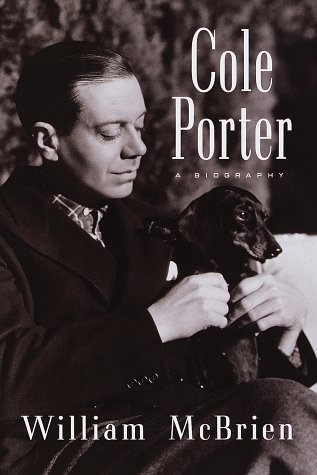
“Cole Porter: A Biography” – Book Review


Recently, I finished reading “Cole Porter: A Biography” by William McBrien (New York: Alfred A. Knopf, 1998 [ISBN: 0394582357]; 459 p.; illustrated).

As a long-time fan of Frank Sinatra, I have always had great admiration for the talents of songwriter Cole Porter; Sinatra recorded many of Porter’s songs – some, multiple times, often with different arrangements.  Like many people, I respect Porter for his ability to write meaningful, witty lyrics that can be insightful – many of which frequently contained clever rhymes.  Hearing stories over the years about interesting aspects of the man’s life, I became increasingly curious, so I sought out a book on his life in order to answer many of my questions.  Based on the result of reading a review in The New York Times, I wound up settling on McBrien’s book.

The book covers Porter’s life from his childhood in Peru, Indiana up to his death at the age of 73 on October 15, 1964.  By many accounts, Porter was quite generous, showing his appreciation of people by not only lavishing them with gifts but also by socializing and inviting them to a great number of parties he was known to throw – quite a few attended by show business celebrities and members from the upper crust of society in those days.  At the same time, however, he developed quite a reputation for being cruel and abrupt with people due to his impatience for lateness and strict adherence to formality. 

Unable to completely deny his homosexuality, Porter insisted on continuing a great many affairs, long after he married a divorced socialite, Linda Lee Thomas.  From the outset, it would seem that the marriage was one of an arrangement – Thomas had suffered from an abusive first marriage and was merely looking for a male companion to see her through her many social engagements.  Porter, on the other hand, needed to use her as a “beard” for the purposes of career advancement; in the meantime, however, he would arrange a great many parties in her absence that were attended by his gay friends and their guests while she would either remain at home due to various illnesses or travel, if her heath condition permitted.

Arguably, the turning point in Porter’s life was when he suffered a horseback riding accident near his Long Island mansion.  With bones crushed in both of his legs when a spooked horse fell on him, Porter underwent dozens of surgeries over a period of decades, suffering a great deal of physical pain and psychological depression all the while.  Needless to say, this experience had both a personal and professional impact on him.  After years of discomfort and countless infections, he ultimately wound up with one of his legs getting amputated towards the end of his life. 

I found the book to be extremely well researched and definitely recommend it to not only any Cole Porter fan, but also, to anyone who loves classic Broadway musicals or to any aficionado of tunes from The Great American Songbook of the 20th Century.  Clearly, the author read volumes of books and articles about his subject but also, interviewed people from that era and included a great many quotes from correspondence between Porter and his wife to their friends.  A gifted yet troubled – and, at times, tormented – man, Porter’s life is a fascinating tale well-told by McBrien in this lovingly crafted book. 

Thursday, August 18, 2011

Aperitifs & Appetizers


programme


Just as an appetizer is a small snack you eat before your entrée in order to whet your appetite, an aperitif is a cocktail specially designed to drink prior to a meal for the very same reason. Recently, I took a course at The Astor Center in New York City where we combined different aperitifs with a variety of appetizers to experiment with an array of flavors that paired well together.


appetizers

Above are the appetizers that were paired with the cocktails we made this evening, which we tasted in order, from left to right: prosciutto and melon; fried chickpeas; olive tapenade on baguette; and salumi e formaggi .

We started the evening by making an Aperol Spritz:

  • 2 ½ ounces Prosecco
  • ¾ ounce of Aperol
  • Splash of soda water,sparkling water or club soda

Combine the ingredients in a rocks glass, top with a couple of ice cubes and garnish with an orange wheel. Serve with melon and prosciutto.

Second was something called Bamboo:

  • 1 ½ ounce dry amontillado sherry
  • 1 ½ ounce Noilly Prat dry vermouth
  • 2 dashes orange bitters
  • 1 dash Angostura bitters
  • Twist of lemon

Stir ingredients with ice until chilled and diluted. Strain into a chilled coupe glass. Garnish with a twist of lemon. Serve with fried chickpeas.

Next was La Bête Verte:

  • ¾ ounce Absinthe
  • ¾ fresh lime
  • ¾ simple syrup
  • 3 ½ parts soda water
  • 4 wheels thinly sliced English cucumbers

Muddle cucumber and simple syrup in your pint glass; add absinthe, lime juice and ice and shake until chilled and diluted. Strain into a highball glass filled with ice and top with soda water. Serve with olive tapenade on baguette.

Finally, we ended the evening with an old standard, The Negroni:

  • 1 ounce Gin
  • 1 ounce Campari
  • 1 ounce Sweet Vermouth

Stir the ingredients in an ice filled mixing glass, then strain into a cocktail (martini) glass and serve with salumi e formaggi.

tools1

While I was familiar with both the Aperol Spritz and The Negroni, the Bamboo and La Bête Verte were new to me. Although I enjoyed the Bamboo, I’d probably be more inclined to want to try making La Bête Verte at home because I like absinthe-based cocktails quite a good deal. Of all the cocktails, I found the Negroni to be the one that stimulated my appetite the most – I’m guessing this was probably because of the bitterness of the Campari.

As far as the appetizers were concerned, they were all quite good, but I would probably be less inclined to fry the chickpeas if I was going to try making one of these at home. So, because I’m lazy, I’d probably want to go with either the melon and prosciutto or the salumi e formaggi; with the latter, however, I would likely be inclined to go with sopressata for the meat.

Have you ever tried any of these appetizers or aperitifs? How did you like them? What did you pair them with (if anything)? Leave us a comment and let us know!

Monday, August 08, 2011

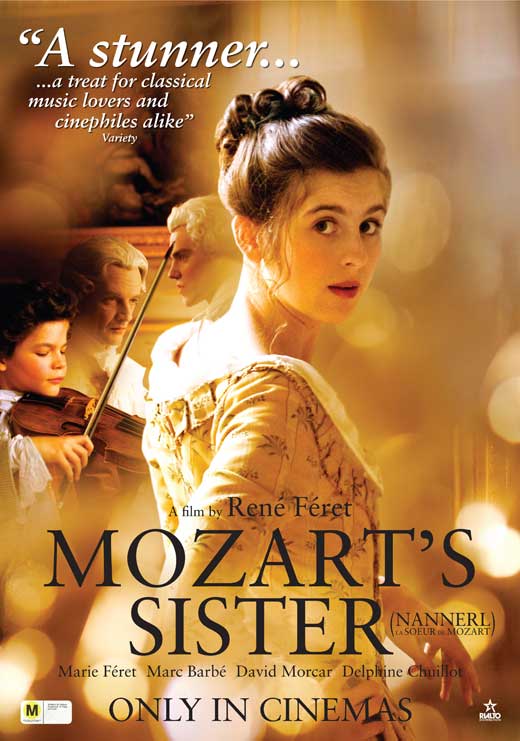
“Mozart’s Sister” – Movie Review


This weekend in my movie class, we had a bonus screening of the French drama “Mozart’s Sister”. 


Synopsis

When Wolfgang Mozart gains a reputation throughout Europe as a child musical prodigy in the 1700’s, his fame begins to outshine his talented older sister – but will she be able to carve out her own niche as a musician?


Story

Leopold Mozart was blessed with two musically gifted children – his daughter Maria-Anna (nicknamed Nannerl) and his son Wolfgang.  Under his tutelage, both children exhibited amazing talents early on, to the point that Leopold would pack up his family and drag them all around Europe to entertain various heads of state in the hope that it would bring them fame and wealth.  Nannerl was a singer, violinist and harpsichord player; her younger brother played the violin and also composed music – his first composition coming at the age of five, earning him the title of prodigy. 

Wolfgang’s notoriety is building at the expense of Nannerl, who is now being overshadowed by her younger brother.  With aspirations to play the violin and compose like her sibling, Nannerl’s abilities are being slowly smothered by her own father, who believes that his time is best spent promoting his son.  In addition, Leopold thinks that women should neither play the violin nor compose music because this is a male-dominated domain.  With a burning ambition that only increases the more she plays music with Wolfgang, Nannerl becomes frustrated and sets out on her own. 

Opportunities for Nannerl are few and far between because she had the misfortune of being born the wrong sex during the 1700’s – in fact, she can’t even apply to study in the music academy because they don’t accept female students.  Eventually, she becomes resigned to her fate and returns to the family to serve as her younger brother’s accompanist.  However, the desire to compose and perform her own compositions still exist, despite the obstacles and rejection she encounters.  Will Nannerl be able to achieve her professional goals or will she be forever destined to take a backseat to Wolfgang?


Review

First off, this is by no means intended to be an historically accurate portrayal of Nannerl’s life – according to the production notes that our instructor shared with us, none of her music survives, so it is impossible to compare her compositions to those of her famous younger brother.  The movie was written, so the story goes, by piecing together what did remain from her time, the letters she wrote to friends and family and those that were written to her.  From there, the filmmakers were able to craft a dramatic story to tell people about a little-known musical talent that was unfortunately lost to our culture centuries ago. 

One would think that after the hit stage play and award winning movie “Amadeus” that the life of Wolfgang Mozart had pretty much been covered.  Little did anyone know exactly how rich his life was for dramatic content.  “Mozart’s Sister” will certainly appeal to women partly because of the feminist angle, but also due to the music, the ornate sets and costumes, which are lavish; there is also a romantic angle to the story, but in all likelihood, it was probably just a dramatic conceit rather than a true event.  There are, however, aspects that may appeal to men as well; the movie gives you an insight into the internecine political squabbling that went on with royalty that is reminiscent of how many businesses may be run even to this day. 

Ultimately, I’ll recommend this movie, but with a few small caveats.  To begin with, the main story takes a while to get going because there is a long set up at the outset of the film; fortunately, the viewers are rewarded because this all winds up paying itself off later on in the movie.  The movie is around two hours in length, but I was surprised how quickly the time went, once the rather long opening set up had completed.  Also, this film is a French production, so both the dialog and, of course, the credits, are in French; the movie makes use of white subtitles to translate the dialog into English, but they are mostly fairly easy to read because they are superimposed over dark backgrounds. 


Tuesday, August 02, 2011

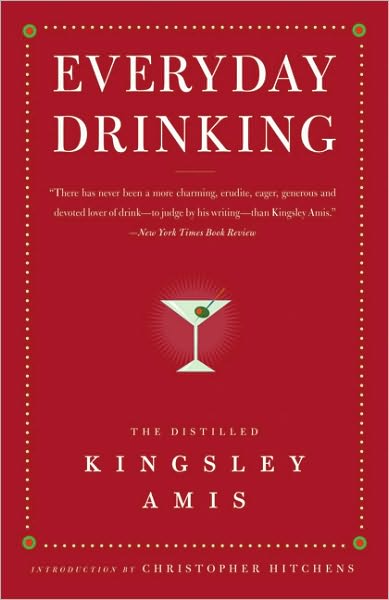
“Everyday Drinking” – Book Review


Recently, I finished reading a book that would be a great read for almost any fan of regular adult beverage intake, so I decided to share it with you in this week’s blog post. The book is called “Everyday Drinking” by Kingsley Amis. It is basically a compilation of both newspaper and magazine articles Amis has written over the years on wide-ranging topics related to drinking – whether it’s the current state of pubs, the proper way to mix a cocktail or how best to either prevent a hangover or treat one after the fact.

The book opens with a sensational introduction by gadfly and controversial author Christopher Hitchens; if you are familiar with his work (I became aware of him around 15 years ago through his guest commentary on news shows rather than through his writing), you will know that this alone would justify the cost of the book. Amis was British and primarily a novelist; perhaps his most famous book was titled, “Lucky Jim” (which also happens to be the name of a cocktail he invented).

“Everyday Drinking” is divided into three main sections: “On Drink”, “Everyday Drinking” and “How’s Your Glass?”. While the rather learned author is most astute on his topic, he is also quite funny, in a snarky kind of way; as a result, you wind up learning quite a good deal as well as being thoroughly entertained – in that regard, you might want to think of him as the British equivalent of Zane Lamprey.

Perhaps the most fun portion of the book is the final section, which is comprised of a series of quizzes on various drinking-related topics that include wine, beer, spirits and mixology; answers to all questions are provided in a subsequent chapter. One warning about the quizzes is that some of them are broken into simple, intermediary and advanced; I personally found that many of the questions in the simple quizzes to be rather difficult, but then again, maybe you’ll have better luck than I. Don’t be fooled as I was: The Cotton Gin was definitely NOT some kind of cocktail based on a certain juniper-infused spirit! Hey, who knew?

Additionally, the book includes a number of cocktail recipes, some of which you may wish to try yourself – depending on how adventurous you are. I add that caveat only because a few of these can be challenging either because they’re somewhat difficult to make or because an occasional ingredient or two you may encounter trouble locating. Nevertheless, they make a fun read, especially when the author discusses their history. Some of the recipes are for cocktails the author himself invented, others are of classic drinks that have been forgotten over the years for one reason or another.

A glossary is included early on and you’d better read it or at least bookmark it because you’ll certainly need to refer to it later on as you proceed through the book. It contains a collection of words and phrases that were rather unfamiliar to me, either because of the fact that they were British terminology or esoteric argot particular to the liquor industry.


Thursday, July 28, 2011

“A Bird Of The Air” – Movie Review


This week in my movie class, we saw the romantic drama “A Bird Of The Air”, which is based on the novel “The Loop” by Joe Coomer.

Synopsis

When a loner’s life is changed by the sudden appearance of a mysterious parrot with an unusual vocabulary, he is forced to come to terms with the personal issues that have plagued him – but after the parrot causes him to meet an unusual young woman who takes a romantic interest in him, will he be able to significantly change enough to maintain a relationship with her?

Story

Lyman’s social skills are perhaps more than just a little bit wanting – he barely ever speaks to anyone and doesn’t have a reputation for initiating conversation with anyone, regardless of whether he knows them well or not. Given this personality quirk of his, Lyman has what might be the perfect job for someone in his position – he’s a highway worker for the state of New Mexico. With no family and no friends, Lyman seems perfectly content with his lifestyle of working a dangerous night shift cleaning up the roads and assisting people who have been in accidents or are experiencing car trouble.

Then, one day while eating breakfast in the trailer he calls a home, an exotic looking parrot flies in through his open door. Right off the bat, the parrot starts chatting up a storm with Lyman, including using quite a few unusual phrases, which, in the context of their interaction, almost makes it appear as though the bird is trying to engage him in an actual conversation. Mystified by his new friend, Lyman decides to care for the parrot while trying to find its rightful owner so that the bird may be returned to its home.

While researching the parrot in the library of the small community college where he takes classes, he meets Fiona, a free-spirited young woman who takes an immediate fancy to Lyman. Despite the fact that their personality is the polar opposite of each other, they strike up a friendship as Fiona offers to help Lyman in his quest to locate the owner of the parrot. But when it becomes clear to Lyman that Fiona’s intentions are to be more than merely his friend, will he somehow be able to allow another person into his life?

Review

A small independent film made on the cheap, “A Bird Of The Air” focuses on its quirky tale, rather than trying to sell itself to an audience by its stars because the movie really doesn’t have any – except for a couple of cameo appearances by familiar faces. At times trying to be funny and at others dramatic, it almost doesn’t seem to know what quite to make of itself. One gets the sense that the filmmakers tried to adhere as closely to its source material as possible. Does it translate? Well, it’s rather hard to say; I found myself wondering at various points during this screening where the story was supposed to be going.

There are some good performances in this movie – especially by the young actress who plays the part of Fiona – but its story has something of a fable-like quality to it and to truly enjoy the movie, you have to acknowledge that and buy into it from the very start. For me, the problem was the fact that the parrot is used as what Hitchcock used to refer to as The McGuffin – it’s really irrelevant to the plot, except as a contrivance to bring the two lead characters together so they can fall in love with each other and set the mechanics of a romance into forward motion.

Prior to the screening, Director Margaret Whitton was interviewed; subsequent to the screening, the two main actors were interviewed – Jackson Hurst (Lyman) and Rachel Nichols (Fiona). Whitton said she had first read the novel on which the film is based about a dozen years ago and wasn’t able to secure the rights to make the movie until years later due to the fact that Oprah Winfrey had originally purchased the option; persistently, she kept inquiring about the availability of its option over the years and once it became available, she pounced on it and decided to make it her directorial debut. Hurst mentioned that while he has done film, TV and stage, he prefers making movies. Nichols said she had something of an unusual audition for the role in the sense that much of it consisted more of an interview with the prospective filmmakers than a reading of Fiona’s part.


Sunday, July 24, 2011

“Crazy, Stupid, Love” – Movie Review


This weekend, my movie class had a bonus screening of the romantic comedy “Crazy, Stupid, Love”, starring Steve Carell, Ryan Gosling, Julianne Moore, Emma Stone, Marisa Tomei and Kevin Bacon.


Synopsis

After a long-time married man learns his wife wants a divorce, he meets someone who decides to turn him into a womanizer – but when his wife later informs him that she wants him back, will they reunite? 


Story

Married for nearly 25 years, the last thing Cal (Carell) expects is to be told by his wife Emily (Moore) that she’s had an affair with a co-worker (Bacon) and now wants a divorce.  Stunned, Cal immediately moves out and tries to get back on track.  Hanging out at singles bars, he’s so out of practice that he strikes out at every opportunity – until he’s spotted by Jacob (Gosling), a young stud who decides to take Cal under his wing and make Cal his pet project.  Teaming up, Jacob gives Cal a makeover and mentors him on how to talk to and pick up women in a bar with similar aplomb. 

Eventually, Cal hits pay dirt with Kate (Tomei), a schoolteacher he meets at the bar.  This success breeds confidence in Cal and he proceeds to pick-up women at an impressive clip.  Around this time, however, Emily is starting to question her desire for the divorce – not so much because she doesn’t appreciate the attention from the co-worker with whom she’s having the affair, but because she genuinely misses her husband … not to mention the fact that friends and family seem to be turning against her somewhat.  Add to this the fact that Cal & Emily’s adolescent son has a crush on the babysitter who is also experiencing unrequited love for Cal and things are rapidly getting very messy. 

Ultimately, Emily begins to see that the romantic entanglement with her co-worker is becoming increasingly cumbersome both at the office and at home.  However, just when Cal finds out that Emily is considering a reconciliation, it all gets called off when she discovers that he’s turned into something of a lothario.  But can Cal somehow win back his wife by convincing Emily that he’s more interested in being her husband than a swinging single?


Review

While a comedy, “Crazy, Stupid, Love” is not really something you would characterize as raucous, ribald or laugh-packed; much of the story has dramatic overtones to it and a good deal of the humor is gentle, understated and spread out.  More mildly amusing than a laugh riot, the funniest scenes come about as a result of some surprising plot twists – one in a big reveal in an uncomfortably awkward scene when Emily and Cal run into one of his spurned, angry conquests and another that concludes the second act in a somewhat farcical tone as all of the different characters and their various subplots converge at a most inopportune moment. 

I would recommend this movie, but with the caveat that you manage your expectations when seeing this romantic comedy – it’s definitely not wall-to-wall gags, but it does have a few genuinely funny moments as described above with more low-key jokes interspersed throughout.  One good thing that the movie has going for it is the fact that the screenwriter managed to combine a number of interesting characters with subplots that are compelling enough to maintain your curiosity about their resolution just as much as you would have for the main story of Cal and Emily.  Some really clever twists and turns occur in crucial plot points as well that will be sure to keep the audience on their toes at all times. 

The majority of the class liked this movie quite a good deal and understandably so, I believe.  Our instructor predicts that this will be a big hit and I would have to agree with him on this one.  I’m a big Marisa Tomei fan and she’s quite funny in the few scenes she has in this movie, but I nevertheless think she was unfortunately and unnecessarily under-utilized here.  If you want some fun, escapist entertainment and have had your fill of Transformers, Harry Potter and Captain America, then this might just be the perfect mid-summer movie for you. 


Friday, July 22, 2011

“Sarah’s Key” – Movie Review


This week in my movie class, we saw the French drama “Sarah’s Key”, starring Kristin Scott Thomas and (in a small role) Aidan Quinn.


Synopsis

An American journalist living in Paris is assigned to write a World War II story for a magazine article – but when her research causes her to investigate the life of a girl from that period, will learning the truth about her risk losing her own family?

Story

Julia (Thomas) and her family have moved to France so she can work on pieces for the Paris bureau of the news magazine that employs her.  Being assigned an article on the French Holocaust known as The Vel' d'Hiv Roundup where the French government had their police arrest Jews living in their country so they could be turned over to the Nazis who occupied their land in mid-July of 1942, her research uncovers the amazing story of a girl named Sarah, who was only 10 years old at the time.  Trying to save her little brother Michel from the Nazis, Sarah locks him in a secret closet in their apartment and makes him promise not to leave until the family’s return in a few days. 

While learning Sarah’s secrets, Julia also winds up learning secrets of her in-laws as well.  It seems that by coincidence, the Paris apartment Julia and her family are about to occupy was the same apartment in which little Sarah lived with her own family during the war; the family of Julia’s in-laws moved into the apartment just weeks after Sarah’s family had been arrested and they have handed down the flat to their son and his wife.  Simultaneously, Julia discovers that she is now pregnant – something of a miracle since doctors told her she would never be able to have more children after giving birth to her daughter, who is now an adolescent.

As Julia uncovers layer upon layer of Sarah’s story, her in-laws’ own mystery begins to unravel, with family members soon learning the horror of the long-kept secret.  Combining this ugly past with the fact that he is faced with a future of suddenly having to care for a quite unexpected baby, Julia’s husband grows angry and distant; not helping matters any is the fact that Julia no longer wishes to live in the family’s apartment upon knowing its history.  On top of that, she is now gallivanting all over the globe in pursuit of a resolution to Sarah’s saga.  But will Julia ever find the truth about Sarah’s ending – and will her family remain intact upon its revelation?

Review

Just in case you need another reminder for why you need to hate the French, along comes “Sarah’s Key” – somewhat ironic, since it’s a French production.  When it was announced in class that this was the movie we would be seeing, a number of people audibly gasped and sighed – all of them women who likely read the novel on which it was based.  While you might be especially taken with this film if you are Jewish or a woman (or both), I have to say that I found it a little on the melodramatic side for my tastes and therefore can’t really feel totally comfortable giving it a recommendation. 

Part of the problem with the movie comes with its heavy-handed treatment of the story and its dialog, not to mention the “magical thinking” nature of things:  Julia’s pregnancy, characterized as a “miracle” (perhaps an immaculate conception, given the apparent aloofness between husband and wife), the coincidence of the apartment and the impossible finding of Sarah’s now middle-aged son (Aidan Quinn).  Especially painful to watch – and listen to, due to the dialog – are the last scenes of the movie, when the actors are given the opportunity for some scenery chewing and the character’s closing remarks falling on your ears as if it were something like a benediction when it seems as though it was intended to be deeply philosophical. 

Prior to the screening, our instructor interviewed Phil Rosenthal, writer/director/star of the hilarious documentary “Exporting Raymond” (see my review here).  Rosenthal was there to promote the fact that the DVD of his documentary is soon to be released.  Just in case you never got around to catching this movie in the theaters in its understandably limited release, I strongly encourage you to rent the DVD.  Rosenthal is one of the most naturally funny raconteurs I have ever had the pleasure of hearing; he has the unique ability to find humor in just about any situation. 


Friday, July 15, 2011

“The Tree” – Movie Review


This week in my movie class, we saw an Australian drama called, “The Tree”, based on a novel titled, “Our Father, Who Art In A Tree”. 

Synopsis

When a young woman suddenly finds herself a widow, she is forced to support and raise her children as a single parent – but when her daughter believes her late father’s spirit lives on in an old tree, the woman also develops a similar emotional attachment. 

Story

In her late 30’s, the last thought Dawn O’Neil has on her mind is becoming a widow – but there she is one day when her husband unexpectedly dies of a heart attack while driving their eight year old daughter Simone home one day.  All of a sudden, Dawn now finds herself forced to raise her four children by herself, all the while still mourning her loss.  Depressed and inconsolable, Dawn sleeps in and is hard to roust from bed, leaving the daily chores to her eldest, a teenage son, who soon seeks a part-time job to pitch-in while remaining in high school.  

After a couple of months, Simone believes she’s made a discovery in the imposing, ancient fig tree that’s grown long and hazardous roots in the family’s backyard – her father, she is certain, is actually alive in that tree.  While she can’t see him or hear him, Simone nevertheless believes that they are able to communicate with each other and continue their familial relationship.  Delighted with her discovery, Simone can’t help but share this with her mother, who, of course, is immediately skeptical, but decides to humor her daughter in any event.  Not long after this, however, Dawn finds herself believing Simone and proceeds to develop her own communication with the dangerous arbor. 

Eventually, Dawn is able to pull herself together enough to get a job as an assistant at a plumbing supply shop where she develops a relationship with George, the proprietor.  Once Dawn’s friendship with George blossoms into a romance, Simone immediately becomes angry because she feels as though her father has been forgotten.  However, when it becomes apparent that the backyard tree is endangering not only the entire family but their house as well, will Dawn be able to sacrifice her relationship both with it and Simone to have it removed for everyone’s safety? 

Review

Sure, it would be incredibly easy to characterize this movie as a “chick flick”.  But would doing so necessarily be a pejorative?  I suppose that depends on what the term “chick flick” might mean to you.  “The Tree” is about feelings and spiritual beliefs and – most ostensibly – about how a grown woman copes with single parenthood in a most unlikely setting.  So, is describing it as “a chick flick” trivializing the film?  Not necessarily, I would suggest, particularly, if that was the intended audience of the filmmakers, which is what appears to be the case – and that’s OK, even if it means it’s not my cup of tea. 

While it may not necessarily be the kind of movie that might cause some women to reach for the tissues every couple of minutes, you might find it a nice alternative while your man sees the latest “Transformers” movie.  Am I generalizing?  Yep, I sure am.  Am I guilty of Sexual Profiling?  Ya, you betcha.  Not apologizing for either one, by the way.  When movies are made, some of them are designed to appeal to the widest possible audience, while others are targeted to a specific demographic; this one fits into the latter category.  Did I love it?  No – I had issues with how quickly and easily Dawn abruptly changed from doubter to believer.  Also, I thought there were too many characters in the story, leaving some to be under-developed or undeveloped; additionally, some of the dialog is a bit clunky, as you might pick up from the trailer, below. 

Prior to the screening, our instructor re-interviewed director Chris Weitz, who was there to follow-up on the interview he gave us when we recently screened his latest movie, the wonderful “A Better Life” (please click here for the review, just in case it missed you).  Weitz went a little more in-depth about his background, describing his close relationship with his brother, four years his senior.  Having a similar sensibility in their youth, they went on to collaborate writing stage plays and screenplays in adulthood; Weitz said that his older brother had greater discipline for the craft of writing, which is why he went on to some success as a playwright. 

Monday, July 11, 2011

Scotch By Region


Recently, I had the opportunity to take a class at The Astor Center of New York City called “Scotch Whisky: A Regional Tasting Tour” where attendees were given the opportunity to sample Scotches from different parts of Scotland to get a better appreciation of how they differed from one part of the country to another. This gave me a chance to not only revisit a couple of my own personal favorites but also, to try ones I’d heard of but never tasted before, as well as to provide an occasion to learn about some that were unfamiliar to me.

The evening actually began not with a Scotch but instead with an old cocktail made with the spirit. Blood & Sand was a cocktail created in the era of silent movies as something of a tribute to the Rudolph Valentino film of the same name. In this flick, Valentino played the part of a bullfighter and it was believed that the combination of ingredients for this drink perfectly matched the spirit of the film. The recipe is as follows:

  • ¾ oz. Benriach 12 year old Scotch
  • ¾ oz. Luxardo Cherry Liqueur
  • ¾ oz. sweet vermouth
  • ¾ oz. orange juice

Shake up all of the ingredients in an ice-filled shaker, then strain into either a coupe glass (which is how we were served the cocktail in class) or a cocktail (i.e., martini) glass.

Benriach Scotch is a peated spirit from the Speyside region of Scotland; the instructor said he used that particular brand of Scotch because it is a relatively inexpensive yet flavorful type of Scotch that lacks any kind of oiliness. Additionally, you will notice that each one of the cocktail’s four ingredients are used in equal parts; the instructor pointed out that this is the mark of what he regarded as a finely crafted cocktail which doesn’t have any one ingredient completely dominating.

We started our tasting with one from the Lowlands region (Auchentoshan 12 year old), then moved north to the Highlands (Old Pulteney 12 year old) and Speyside (Glenrothes Select Reserve Single Malt, Glendronach 15 year Single Malt) before going to Campbeltown (Springbank 10 year old Single Malt) and finishing up with the islands – specifically, Islay (Laphroaig 10 year old and Port Charlotte PC7). In tasting each Scotch, we sample the dram first on its own, beginning with a thorough nosing to get a sense of its aroma, then tried it with a few drops of water added to see how this changed the chemical composition as well as to determine if it made the Scotch better or worse or merely different. This blog post will concern itself with only the first and last items from the tasting menu as these were two extremes.


The Lowlands region is in the southern portion of Scotland, near Ireland. Its Scotches are triple-distilled and contain no peat, which tends to make them good as an introductory Scotch. We tried an Auchentoshan 12 year old from the Lowlands, an 80 proof spirit aged in a combination of both bourbon and sherry casks. Adding the water to it released its sweetness; its lightness made for a good summertime Scotch.


Ending the evening was the Islay-based Port Charlotte (PC7). Aged only seven years, this had an even peatier and smokier nose and taste than even Laphroaig, which we had just tasted. This one also had the strongest alcohol content at 122 proof – as a result of that combination, there were quite a few people who started to cough and choke because they weren’t ready for such a powerful Scotch.

Have you ever tried any of the Scotches on this menu?  If so, please leave a comment and share your experience.